
Submersible Water Level Sensors: Complete Guide for Water Tanks
Accurate liquid measurement is essential in water treatment plants, storage tanks, reservoirs, wells, irrigation systems, and industrial processes. Among different technologies, the submersible water level sensor is one of the most widely used solutions for continuous liquid level measurement because of its reliability, accuracy, and ability to work in harsh environments.
Table of Contents
- 1. What Is a Submersible Water Level Sensor?
- 2. How Does a Submersible Level Sensor Work?
- 3. Hydrostatic vs Ultrasonic vs Radar Level Sensor
- 4. How to Select the Right Submersible Water Tank Level Sensor?
- 5. Recommended Applications of Submersible Water Level Sensors
- 6. Case Study: Water Tank Level Monitoring Solution for Industrial Water Supply in Southeast Asia
- 7. Troubleshooting Common Tank Level Sensor Problems
- 8. FAQs
- 9. About HOLYKELL
- 10. About the Author
1. What Is a Submersible Level Sensor?
A submersible level transmitter is a pressure-based liquid level sensor that is installed directly into a liquid. It converts the pressure generated by the liquid column above the sensor into an electrical signal proportional to the liquid height.
A typical submersible water level sensor consists of:
Pressure sensing element: The sensing diaphragm detects the pressure caused by the liquid above the sensor.
Housing: Industrial water level sensors usually use SUS304, SUS316L stainless steel, titanium, PVDF materials.
Cable: The cable assembly is an essential part. It provides power supply, signal transmission, and mechanical support during installation.
Signal processing circuit: The internal electronics convert pressure signals into standardized outputs for PLC systems, SCADA systems, or IoT platforms.
2. How Does a Hydrostatic Level Sensor Work?
A hydrostatic level sensor works based on the relationship between liquid pressure and liquid height.
The basic principle is: The deeper the sensor is placed in a liquid, the greater the pressure generated by the liquid column above the sensor. The sensor measures this pressure and calculates the liquid level.
The fundamental formula is: P = ρgh
Where:
- P=Hydrostatic pressure (Pa)
- ρ = Liquid density (kg/m³)
- g = Gravity acceleration (9.81 m/s²)
- h = Liquid height above sensor (m)
Simple Working Diagram of Hydrostatic Level Sensor

Hydrostatic Level Measurement Principle
Example:
A water tank has:
- Water density: ρ = 1000 kg/m³
- Gravity acceleration: g = 9.81 m/s²
- Water depth: h = 5 meters
The pressure at the bottom of the tank is:
P = ρgh
P = 1000 × 9.81 × 5
P = 49,050 Pa
Therefore:
5 meters of water creates approximately 49 kPa pressure.
The submersible water level sensor measures this pressure and converts it into a level value.
3. Hydrostatic vs Ultrasonic vs Radar Level Sensor: Which One Is Better?
There is no single “best” water level sensor for every application. The right choice depends on the liquid condition, installation environment, accuracy requirements, and budget.
The three most common technologies are:
- Hydrostatic (submersible) level sensor
- Ultrasonic level sensor
- Radar level sensor

Technology Comparison
| Feature | Submersible Level Sensor | Ultrasonic Level Sensor | Radar Level Sensor |
|---|---|---|---|
| Measurement Principle | Hydrostatic pressure P=ρgh | Ultrasonic wave reflection | Microwave electromagnetic wave |
| Installation | Direct immersion | Mounted above liquid | Mounted above liquid |
| Contact with Liquid | Yes | No | No |
| Accuracy | High | Medium | Very high |
| Cost | Economical | Medium | Higher |
| Foam Influence | Low | High | Low |
| Vapor Influence | Low | Medium | Low |
| Maintenance | Medium | Low | Low |
| Deep Tank Measurement | Excellent | Limited by range | Excellent |
| Corrosive Liquid | Requires suitable material | Suitable | Suitable |
| Power Consumption | Very low | Medium | Medium |
| Typical Applications | Water tanks Wells Reservoirs Irrigation systems Wastewater tanks Underground water |
Open channels Wastewater tanks Chemical tanks Applications requiring non-contact measurement |
Large industrial tanks Chemical storage High-temperature applications Difficult process environments |
4. How to Select the Right Submersible Water Tank Level Sensor?
Selecting the correct submersible water level sensor for water tank applications requires more than simply choosing a measurement range. The sensor must match the tank structure, liquid characteristics, environmental conditions, and monitoring requirements.
The following factors should be considered before selecting a water tank level sensor.
Measure the Tank Height and Required Measuring Range
The first step is determining the maximum liquid height.
For example:
- 3-meter water tank → select 0-5m range
- 10-meter reservoir → select 0-15m range
- 30-meter well → select 0-50m range
It is recommended to select a measurement range slightly higher than the actual liquid height to avoid sensor overload.
Example:
A 5-meter tank should not use a 0-5m sensor operating at its maximum limit continuously. A larger range sensor usually provides better long-term reliability.
Consider Liquid Type and Density
Hydrostatic measurement depends on P = ρgh
Because liquid density affects pressure, different liquids require different calibration. Therefore, when selecting a liquid level sensor, always confirm:
- Liquid density
- Chemical compatibility
- Corrosiveness
- Temperature
Select the Correct Accuracy Level
Different applications require different accuracy. Typical accuracy options:
| Typical Accuracy | Applications |
|---|---|
| ±0.5% F.S | General water tanks |
| ±0.25% F.S | Industrial monitoring |
| ±0.1% F.S | Precision applications |
For normal water level monitoring, ±0.5% F.S. is usually sufficient. For industrial water plants and calibration systems, higher accuracy may be required.
Choose the Right Output Signal
Select according to system requirements:
| System | Recommended Output |
|---|---|
| PLC | 4-20mA |
| SCADA | RS485 Modbus |
| Cloud platform | NB-IoT / 4G / LoRa |
Check Installation Environment
A submersible sensor may operate in different applications, consider its IP rating, liquid temperature, ambient temperature, lightning and surge protection.
Sensor Material
Common materials:
| Material | Application |
|---|---|
| SUS304 | Normal water |
| SUS316L | Corrosive liquids |
| PTFE coating | Chemical applications |
| Titanium | Highly corrosive, high salinity & temp, strongly oxidizing environments |
Power Supply
Select the proper power supply according to the requirement.
Environmental Protection
Consider:
- IP rating
- Outdoor installation
- Temperature changes
- Lightning risk
Maintenance Requirements
A good water level sensor should provide:
- Stable zero point
- Long service life
- Easy replacement
Integration Capability
Modern industries require sensors that can connect with:
- PLC
- IoT gateways
- Cloud platforms
- Mobile applications
5. Recommended Applications of Submersible Water Level Sensors
Submersible level transmitters are widely used in:
| Industry | Application |
|---|---|
| Municipal Water | Water tanks, reservoirs, pump stations |
| Agriculture | Irrigation tanks, groundwater monitoring |
| Wastewater | Sewage tanks, treatment plants |
| Industrial Manufacturing | Process water tanks |
| Mining | Underground water monitoring |
| Energy | Cooling water systems |
| Buildings | Fire water tanks |
6. Case Study: Water Tank Level Monitoring Solution for Industrial Water Supply in Southeast Asia
Client Background
A municipal water utility in Southeast Asia operates an extensive distribution network feeding several industrial manufacturing estates. The primary hub relies on four outdoor buffer tanks (each 8 meters high) located 12 km from the regional central control room. These tanks act as the critical buffer to stabilize delivery pressure and prevent supply disruptions to manufacturing lines that operate 24/7.
Challenges:
Costly and delayed manual rounds: Two field operators drove 45 minutes twice a day just to climb access ladders and take dip-tape readings. By the time shift reports reached dispatch, the data was already hours out of date.
Costly pump dry-run incidents: During peak shift changes in the dry season, sudden demand spikes caused water levels to plunge undetected. In one instance, a booster pump ran dry for over 40 minutes, causing impeller cavitation and a $3,200 repair bill alongside unscheduled plant downtime.
Tropical environmental stress: Earlier attempts using float switches failed within six months. The combination of intense monsoon deluges, ambient temperatures topping 38°C, and 95% relative humidity regularly led to signal drift and internal moisture ingress at cable entry points.
System Deployment
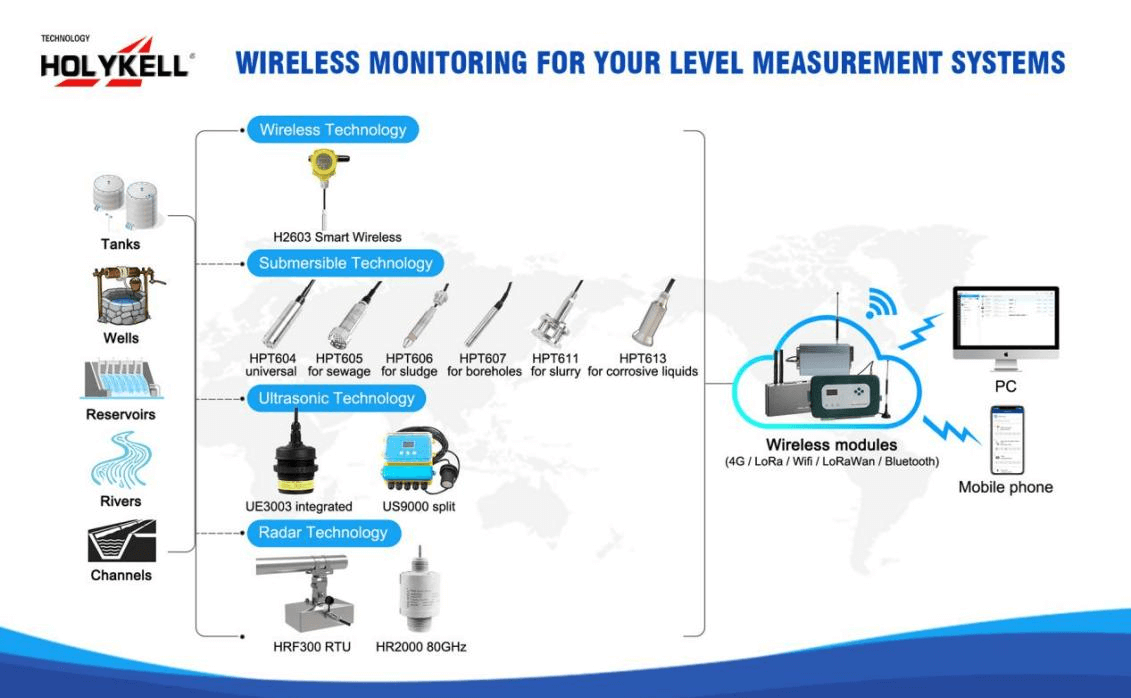
The engineering team deployed HPT604 series submersible level transmitters directly into each buffer tank.
Operational Results
Zero Dry-Run Failures: Setting lower/high level limits completely eliminated dry-run and overflow incidents over 18 months of continuous runtime.
85% Drop in Routine Site Trips: Daily manual climbing inspections were eliminated. Site visits are now limited to quarterly visual checks, saving roughly 26 man-hours per week.
Uninterrupted Signal Stability: Across heavy monsoon seasons, the IP68-sealed housing and desiccant-protected vent system maintained consistent zero-point stability with zero recorded signal drift.
7. Troubleshooting Common Tank Level Sensor Problems
| Problem | Possible Causes | Recommended Solutions |
|---|---|---|
| Output Signal Is Incorrect | • Wrong measuring range • Incorrect wiring connection • Sensor zero drift • Incorrect liquid density setting |
• Check power supply voltage • Verify wiring and connection • Recalibrate the sensor • Confirm liquid parameters (density, temperature, etc.) |
| Sensor Reading Is Unstable | • Strong water turbulence • Pump vibration • Electrical interference |
• Install the sensor away from pump outlets or strong flow areas • Add signal filtering if required • Check grounding and improve EMC protection |
| Sensor Shows Zero Output | • Cable damage • No power supply • Blocked pressure port or sensing diaphragm |
• Check cable connection and wiring • Measure supply voltage • Clean the sensor diaphragm and pressure inlet |
| Measurement Error Increases Over Time | • Sediment accumulation on sensor diaphragm • Sensor aging • Chemical corrosion or material incompatibility |
• Clean the sensor regularly • Select suitable sensor materials (such as SUS316L or titanium housing) • Replace damaged components when necessary |
| Atmospheric Pressure Compensation Failure | • Vent tube blocked • Damaged vented cable • Moisture entering the cable |
• Use a properly designed vented cable • Keep the cable ventilation end dry and protected • Check the vent tube for blockage |
8. FAQs
What is a vented tube in a submersible water level sensor?
A vented tube is a small air channel inside the sensor cable that allows atmospheric pressure to reach the reference side of the pressure sensor.
Because hydrostatic measurement uses:
P = ρgh
the sensor must compensate for atmospheric pressure changes.
What factors affect accuracy of liquid level probes in different liquids?
The accuracy of liquid level probes can be affected by:
- Liquid density changes
- Temperature variation
- Chemical corrosion
- Sediment or particles
- Sensor installation position
- Atmospheric pressure compensation
For different liquids, the sensor should be calibrated according to actual density and application conditions.
Which water level sensor is best for bulk liquid storage in industrial settings?
For large water tanks and bulk liquid storage, the best choice depends on the application.
Submersible hydrostatic level sensors are ideal for water tanks, reservoirs, and cost-effective continuous measurement.
Radar level sensors are preferred for high-temperature, corrosive, or non-contact industrial applications.
For general industrial water storage, a reliable hydrostatic water level sensor usually provides the best balance between accuracy, stability, and cost.
What is the most accurate water level sensor for industrial use?
Radar level sensors generally provide the highest accuracy for non-contact measurement, with some models achieving millimeter-level accuracy. However, for submerged measurement applications, high-quality hydrostatic level transmitters can provide excellent accuracy, typically up to ±0.1% F.S., while offering easier installation and lower cost.
Can a submersible water level sensor measure wastewater?
Yes. A submersible water level sensor can measure wastewater when:
- The sensor material is corrosion-resistant
- The diaphragm is protected
- The installation prevents heavy sediment accumulation
How long does a submersible level transmitter last?
The service life depends on:
- Liquid characteristics
- Installation environment
- Sensor quality
- Maintenance
Industrial-grade hydrostatic level sensors can typically operate for many years under proper conditions.
Can a submersible level sensor work without electricity?
Most industrial submersible water level sensors require external power. While for some models, especially for remote applications, battery-powered sensors are available.
What is the difference between a water level sensor and a water level switch?
A water level sensor provides continuous measurement.
Example:
Tank level: 0%-100%
A water level switch only detects specific points.
Example:
High level alarm / Low level alarm
For automatic tank level monitoring, a sensor is usually more suitable.
Can a submersible level sensor be used outdoors?
Sure.
Can a water level sensor connect to an IoT platform?
Yes. We can use wireless gateway to transmit the data to an IoT platform.
9. About HOLYKELL
HOLYKELL is a professional industrial sensor manufacturer specializing in:
- Fuel level sensors
- Level transmitters
- Pressure sensors
- Flow meters
- Wireless IoT monitoring solutions
With more than 25 years of experience in sensor technology, HOLYKELL provides reliable measurement solutions for transportation, energy, water treatment, and industrial automation industries.
From sensor design to cloud integration, HOLYKELL helps customers build smarter and safer monitoring systems.
10. About the Author
Senior Engineer at Holykell
Li Fei serves as a Senior Engineer at Holykell, with extensive experience in industrial measurement technologies and smart monitoring solutions. Over the past 15 years, he has focused on the development and application of pressure measurement, level sensing, and Industrial IoT technologies, providing reliable sensing solutions for customers in various industries worldwide.
Throughout his career, Li Fei has participated in hundreds of customized projects involving water and wastewater management, oil and gas applications, chemical processing, agricultural monitoring, and industrial automation. His expertise includes selecting suitable level and pressure instruments, building remote monitoring platforms, and optimizing sensor systems for challenging operating environments.
He has contributed to the design of intelligent monitoring solutions for applications such as remote water resources, fuel storage facilities, industrial tanks, and automated equipment. His work focuses on improving measurement accuracy, communication reliability, and system stability through advanced sensor technologies and wireless data transmission solutions.
Li Fei holds a Bachelor’s degree in Automation Engineering and is committed to advancing the integration of sensing technology and Industrial IoT. Through continuous innovation and practical application experience, he helps global customers achieve more efficient operations, smarter asset management, and digital transformation.