
Multi-Site Distributed Diesel Tank Telemetry: 4G IoT Monitoring & Water-in-Fuel Interface Detection
Quick Answer: What Is the Best Solution for Monitoring Multiple Diesel Tanks Remotely?
A 4G IoT remote diesel tank monitoring system is an effective solution for managing multiple fuel storage tanks across geographically distributed locations.
It combines three essential components:
Fuel Level Sensors: Magnetostrictive sensors can measure diesel levels and, with a suitable dual-float configuration, detect the water-fuel interface.
4G Industrial DTUs: Devices such as the HK301 transmit measurement data from remote tanks to a central server through cellular networks, depending on project configuration.
Cloud Monitoring Platform: Operators can monitor fuel inventory in liters, track water accumulation, view historical data, and receive high-level or low-level alarms through a centralized dashboard.
For fuel distributors, logistics fleets, and industrial operators managing 30 or more diesel tanks, this architecture provides centralized inventory visibility and reduces dependence on manual inspections.
The appropriate system configuration depends on tank dimensions, measurement requirements, cellular coverage, installation conditions, and cloud integration needs.
1.Why Do Distributed Diesel Storage Sites Need Remote Monitoring?
Managing diesel fuel across multiple storage locations is not simply a matter of measuring tank levels. For fuel distributors, logistics fleets, and industrial diesel stations, the real challenge is knowing how much fuel is available at every site, identifying abnormal conditions, and preventing water contamination before it causes equipment damage.
When diesel tanks are distributed across different facilities, industrial parks, or remote operating locations, manual inspection becomes increasingly expensive and inefficient.
A typical operation may involve:
- Multiple diesel storage tanks distributed across multiple locations.
- Long distances between storage facilities and the central management office.
- Limited on-site personnel and frequent manual tank inspections.
- Water accumulation at the bottom of diesel tanks.
- Delayed detection of low fuel levels, abnormal consumption, or water contamination.
- Difficulties consolidating inventory data from different locations.
A local fuel level gauge can show how much diesel is inside an individual tank, but it cannot provide centralized visibility across an entire fuel storage network.
This is where a 4G IoT remote diesel tank monitoring system becomes valuable. By combining fuel level sensors, water-in-fuel interface detection, industrial 4G communication devices, and a cloud-based monitoring platform, operators can manage multiple diesel tanks remotely from one central location.
2.How Does a Multi-Site 4G Diesel Tank Monitoring System Work?
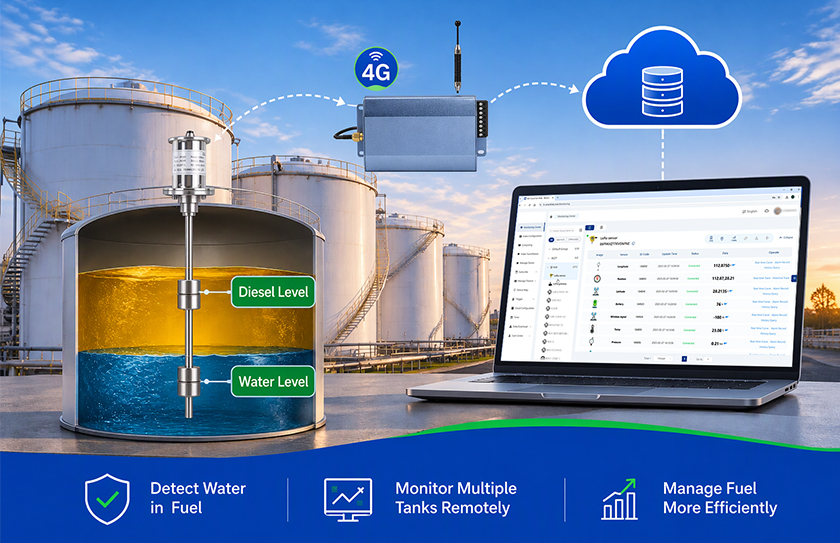
A multi-site diesel tank telemetry system connects individual storage tanks to a centralized monitoring platform through wireless communication.
Each tank is equipped with a suitable fuel level sensor. Depending on the monitoring requirements, the sensor can also detect the interface between diesel and accumulated water.
The measurement data is transmitted through an industrial data transmission unit (DTU) using a 4G cellular network and uploaded to a remote server or cloud platform.
2.1. Fuel Level and Water Interface Measurement
A fuel level sensor is installed inside each diesel tank to measure the liquid level. For applications requiring water contamination monitoring, a magnetostrictive sensor can be selected to provide both:
Fuel level: The total height of diesel in the tank.
Water interface level: The height of the water layer accumulated at the bottom of the tank.
The appropriate sensing technology depends on tank construction, fuel characteristics, required accuracy, interface thickness, installation conditions, and the sensor’s available measurement outputs.
2.2. Data Transmission Through a 4G Industrial DTU
The sensor outputs are connected to an industrial data transmission unit, such as the HK301 4G DTU.
The DTU collects measurement data and transmits it through the cellular network to a central monitoring platform.
A typical communication architecture is:
Fuel Level Sensor → 4G DTU → Cellular Network → Cloud Platform → Central Monitoring Dashboard
Unlike short-range wireless communication, 4G cellular communication does not require the tank and control room to be within direct radio range of each other.
As long as the remote sites have suitable cellular network coverage and the devices are correctly configured, data can be transmitted over long geographical distances.
This makes 4G a practical option for distributed diesel storage networks where tanks may be separated by tens or hundreds of kilometers.
2.3. Centralized Cloud Monitoring
Once the data reaches the cloud platform, authorized users can view the status of multiple diesel tanks through a unified dashboard.
Typical monitoring functions include:
- Real-time or scheduled fuel level monitoring.
- Water interface level monitoring.
- Tank inventory calculation in liters.
- High-level and low-level alarms.
- Water accumulation alerts.
- Historical measurement records and trend analysis.
- Remote access to tank information from different locations.
The platform can organize tanks by site, facility, or operating area, making it easier to manage a large fuel storage network.
3.Why Is Water-in-Fuel Interface Detection Important?
One of the most serious risks in diesel storage is water accumulation at the bottom of the tank.
Water can enter a diesel tank through condensation, contaminated fuel deliveries, leaking tank covers, damaged seals, or other environmental factors. Because water is denser than diesel, it generally settles at the bottom of the tank and forms a separate liquid layer. If this water is not detected and removed, it may eventually enter the fuel supply system.
For logistics fleets, construction equipment, backup generators, and industrial diesel stations, an unexpected fuel system failure can interrupt operations and increase maintenance expenses.
A conventional single-point fuel level sensor cannot necessarily identify the water layer at the bottom of a tank.
For applications where water contamination is a major concern, fuel level and water interface measurement should be considered together.
4.How Does a Magnetostrictive Fuel Level Sensor Work?
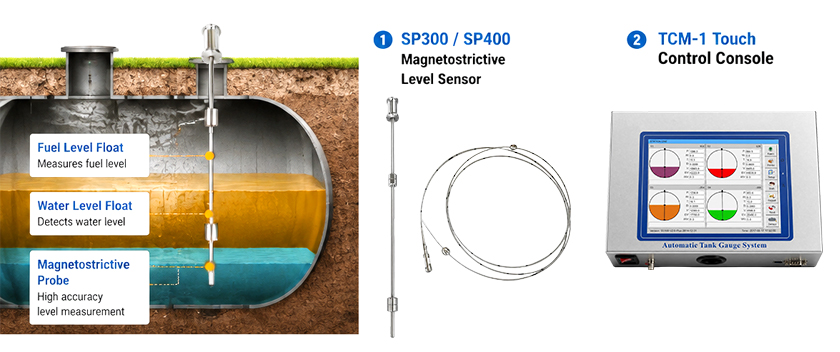
A magnetostrictive fuel level sensor uses magnetic floats and a sensing probe to measure liquid levels with high accuracy. It can provide continuous fuel level measurement and, with a suitable dual-float configuration, detect the water-fuel interface at the bottom of a diesel tank.
5. How to Monitor Multiple Diesel Tanks Across Multiple Locations?
A distributed fuel storage project requires more than installing a sensor in each tank. The monitoring architecture must also support multiple measurement points, long-distance communication, centralized data management, and practical alarm configuration.
Consider a diesel distribution company operating more than 30 storage tanks across several facilities. The management team needs to answer four important questions:
- How much diesel is available at each location?
- Which tanks are approaching their low-level limits?
- Is water accumulating at the bottom of any tank?
- Can headquarters monitor all locations without sending employees to each facility?
A centralized 4G telemetry architecture can address these requirements.
Step 1: Install Sensors in Each Diesel Tank
Each tank is equipped with a fuel level sensor selected according to its height, structure, installation opening, and measurement requirements.
For tanks requiring water monitoring, select a sensor capable of measuring both the fuel surface and the water-fuel interface.
Each sensor should be assigned a unique identification number to ensure that its measurements are associated with the correct tank.
Step 2: Connect the Sensors to a 4G DTU
The sensor signals are connected to an industrial 4G DTU. The communication configuration depends on the sensor output, such as RS485 or another supported signal interface.
The DTU collects the measurement data and sends it to the cloud platform through the local cellular network.
For projects involving multiple tanks, the number of DTUs, supported channels, wiring arrangements, and communication settings should be determined during system design.
Step 3: Transmit Data Over Long Distances
For distributed storage facilities, the communication distance between a tank and the headquarters may reach approximately 200 km.
4G communication makes centralized monitoring possible without requiring a dedicated long-distance cable between each remote site and the control room.
However, the actual communication performance depends on cellular coverage, network stability, antenna installation, device configuration, and server connectivity.
A site survey is recommended before deployment, particularly for remote industrial facilities with weak mobile signals.
Step 4: Convert Liquid Level into Fuel Volume
Tank level data is useful, but inventory managers generally need to know the actual fuel volume in liters.
The cloud platform can convert measured liquid height into estimated tank volume using the tank’s dimensional information or a calibrated level-to-volume table.
For regular cylindrical tanks, a geometric calculation may be sufficient if the tank shape and installation conditions are suitable.
For horizontal cylindrical tanks, irregular tanks, or tanks with internal structures, a calibrated strapping table is generally more appropriate.
This allows managers to view fuel inventory in liters instead of interpreting raw millimeter readings.
Step 5: Configure Centralized Alarms
Alarm thresholds can be configured according to each tank’s operating requirements. Alarm rules should be configured with suitable delays and thresholds to reduce unnecessary notifications caused by fuel movement, filling operations, or measurement fluctuations.
6. Real-World Applications of Remote Diesel Tank Monitoring
Application 1: Remote Monitoring of More Than 30 Diesel Tanks in Saudi Arabia
A fuel storage project in Saudi Arabia demonstrates the value of centralized remote monitoring for geographically distributed diesel storage facilities.
Project Requirements
The customer needed to monitor more than 30 diesel storage tanks and transmit measurement data to a central management location.
The main requirements included:
- Remote monitoring of more than 30 diesel tanks.
- Measurement of diesel levels and water-fuel interface levels.
- Long-distance data transmission over approximately 200 km.
- Centralized monitoring through a 4G communication architecture.
- Improved visibility of fuel inventory and water accumulation.
Application 2: Ultrasonic Diesel Tank Monitoring with GPS in Mali
Not every distributed diesel monitoring project requires water interface detection. In another project in Mali, the monitoring requirements focused on diesel tank level measurement combined with GPS positioning.
An ultrasonic level measurement solution can be considered when the application requires non-contact measurement from the top of a tank and the installation conditions are suitable.
GPS information adds location visibility, which is particularly useful for mobile fuel storage assets, remote facilities, or operations involving multiple geographical locations.
This project illustrates an important point: the monitoring system can be selected according to the actual operating requirements rather than using the same sensor configuration for every diesel tank.
For stationary tanks requiring water accumulation monitoring, interface measurement may be essential.
For mobile tanks or location-based inventory management, ultrasonic measurement and GPS positioning may be more relevant.
7.How to Choose the Right Remote Diesel Tank Monitoring Solution
Before selecting sensors and communication devices, project engineers should evaluate several technical factors.
7.1. Choose the Right Fuel Level Measurement Technology
| Measurement Technology | Key Advantages | Best-Suited Applications | Selection Considerations |
|---|---|---|---|
| Magnetostrictive Level Sensor | High measurement accuracy, excellent repeatability, and continuous level measurement of diesel level and the water-fuel interface | Diesel storage tanks requiring precise inventory measurement, water accumulation monitoring, and long-term fuel management. | Requires proper float selection, suitable installation space, and compatibility with the stored liquid. |
| Radar Level Sensor | Non-contact measurement, high accuracy, strong adaptability to demanding environments | Large diesel storage tanks, industrial fuel depots, and applications where non-contact measurement is preferred. | Performance depends on antenna selection, installation position, tank geometry, and potential interference from internal structures or obstructions. |
| Ultrasonic Level Sensor | Non-contact measurement, easy installation, no moving parts, and cost-effective | Diesel tanks with suitable top-mounted installation conditions and applications requiring basic remote fuel level monitoring. | Measurement affected by temp variations, vapor, foam, condensation, and obstructions between the sensor and liquid surface. |
How to Choose?
- Choose magnetostrictive technology when high-accuracy fuel inventory measurement and water-fuel interface detection are important.
- Choose radar technology when non-contact measurement, reduced mechanical maintenance, and reliable operation in demanding tank environments are priorities.
- Choose ultrasonic technology when you need a relatively economical, non-contact solution for conventional tank level monitoring.
7.2. Select the Appropriate Communication Method
| Communication | Suitable Applications | Key Considerations |
|---|---|---|
| 4G | Distributed facilities with cellular network coverage | SIM card, signal strength, data costs, and network availability |
| NB-IoT | Low-power remote monitoring where operator coverage is available | Coverage, data transmission requirements, and network compatibility |
| LoRa / LoRaWAN | Multiple nearby tanks within a private or managed wireless network | Gateway placement, coverage, and network planning |
| RS485 | Local wired communication between sensors and controllers | Cable distance, wiring, and electrical interference |
For projects involving geographically separated storage sites, 4G is often a practical choice because it can connect remote locations directly to a central server through cellular networks.
For multiple tanks within the same facility, LoRa or RS485 may also be considered depending on the site layout.
7.3. Check Tank Dimensions and Installation Conditions
Accurate fuel inventory monitoring requires more than choosing a sensor with the correct measurement range. The following parameters should be confirmed:
- Tank height.
- Tank shape: vertical cylindrical, horizontal cylindrical, or irregular.
- Installation opening and available mounting space.
- Fuel type and operating temperature.
- Required measurement accuracy.
- Whether water interface detection is required.
- Sensor output and power supply.
- Hazardous-area classification and applicable certification requirements.
7.4. Define Cloud Monitoring and Alarm Requirements
Before deployment, determine how operators will use the monitoring platform.
For example:
- How many tanks need to be displayed?
- Are high-level and low-level alarms required?
- Is historical data storage required?
- Do different users need different access permissions?
Defining these requirements early helps avoid communication and platform compatibility problems during implementation.
8.Frequently Asked Questions About Remote Diesel Tank Monitoring
1. Can a remote fuel monitoring system work with existing diesel storage tanks?
Yes. Remote fuel monitoring systems can generally be retrofitted to existing diesel tanks without replacing the entire storage infrastructure. The installation method depends on the tank structure, available mounting openings, sensor dimensions, and electrical connections. A site assessment helps determine whether existing tank openings can be used.
2. What happens if the 4G network temporarily loses connection?
If cellular communication is interrupted, remote data transmission may temporarily stop. Depending on the DTU’s supported functions, measurement records can be stored locally and uploaded after communication is restored.
3. Can a diesel tank monitoring system integrate with an existing SCADA or fuel management system?
Yes, integration may be possible through supported industrial communication protocols and data interfaces. Depending on the system architecture, measurement data can be transferred to existing SCADA, PLC, or fuel management platforms. Confirm protocol compatibility, register mapping, data formats, and network security requirements before implementation.
Design Your Multi-Site Diesel Tank Monitoring System with Holykell
To recommend a suitable solution, please Submit Your Tank Parameters → Get Technical Selection → Discuss Your Monitoring Solution with Holykell.
About the Author
Holykell Technical Team specializes in industrial pressure, level, and flow measurement technologies, as well as remote monitoring solutions for industrial applications. The team shares practical engineering knowledge to help customers select suitable sensing technologies and build reliable monitoring systems.