
Level Sensor Certifications Guide: What Certifications Should You Check Before Buying a Level Transmitter?
When purchasing a level sensor or level transmitter, many buyers focus on measurement range, accuracy, output signal, and price. However, certifications are equally important because they determine whether the instrument can be legally installed, safely operated, and accepted in your target market.
Different industries and regions have different certification requirements. A level transmitter used for a water tank may only need basic certifications, while a level sensor installed in an oil storage tank or chemical plant may require explosion-proof approvals.
This guide explains the most common level sensor certifications by region, application category, and importance, helping you choose the right product and avoid compliance problems after purchase.
1. Why Are Certifications Important for Level Sensors?
Certifications provide proof that a level sensor meets specific safety, quality, and performance requirements.
For industrial buyers, certifications can help to:
- Ensure compliance with local regulations
- Reduce risks during installation and operation
- Pass project approval and customer inspection
- Improve equipment reliability in harsh environments
- Simplify future maintenance and replacement
Before placing an order, it is recommended to confirm not only the sensor specifications but also whether the certifications match your application and market.
2. Level Sensor Certifications by Importance
Not every certification is required for every application. The importance depends on where and how the level transmitter will be used.
| Priority | Certification | Importance | Typical Applications |
|---|---|---|---|
| High | CE | Basic market access for many countries | Industrial automation, water treatment, general applications |
| High | Calibration Certificate | Verifies measurement accuracy | Industrial projects, OEM applications |
| High | IP67/IP68 Protection Rating | Confirms waterproof and dustproof performance | Submersible level sensors, outdoor monitoring |
| High | ATEX | Explosion-proof approval for hazardous areas | Oil, gas, chemical industries |
| High | IECEx | International explosion-proof certification | Global hazardous area projects |
| Medium | RoHS | Restriction of hazardous substances | European and international markets |
| Medium | UL/cUL | Electrical safety certification | USA and Canada |
| Medium | FCC | Electromagnetic compatibility | Wireless level sensors in USA |
| Medium | NSF/ANSI 61 | Drinking water safety | Water supply and treatment |
| Medium | WRAS | Drinking water approval | UK water industry |
| Low | EAC Ex | Explosion-proof certification for EAEU countries | Russia and related markets |
3. Level Sensor Certifications by Region
Different markets usually focus on different certifications.
| Region | Common Certifications | Purpose | Typical Applications |
|---|---|---|---|
| Europe | CE | General product compliance and market access | General industrial applications |
| ATEX | Explosion-proof certification for hazardous areas | Oil, gas, chemical, and explosive environments | |
| RoHS | Restriction of hazardous substances | Environmental compliance requirements | |
| RED | Wireless communication product approval | Wireless level sensors and IoT devices | |
| North America (USA & Canada) | UL / cUL | Electrical safety certification | Industrial equipment and control systems |
| FCC | Electromagnetic compatibility approval | Electronic and wireless products | |
| NSF/ANSI 61 | Drinking water safety certification | Municipal water and drinking water systems | |
| International Industrial Projects | IECEx | International explosion-proof certification | Global hazardous area projects |
| ATEX | European hazardous area certification | Oil, gas, and chemical industries | |
| Calibration Certificate | Measurement accuracy verification | Industrial projects and quality inspection | |
| Australia & New Zealand | AS/NZS 4020 | Drinking water contact material safety | Water supply and treatment applications |
| CE | General imported equipment compliance | Industrial equipment | |
| IECEx | Hazardous area certification | Mining, oil, and gas industries | |
| Russia & EAEU Countries | EAC | General product compliance within EAEU market | Industrial equipment exports |
| EAC Ex | Explosion-proof equipment approval | Oil, gas, chemical, and hazardous environments |
4. Certifications by Application
The required certifications depend on how and where the level sensor is installed.
1) General Water Level Monitoring
Examples:
- Water tanks
- Reservoirs
- Rivers
- Wastewater tanks
- Irrigation systems
Recommended certifications:
| Certification | Why It Matters |
|---|---|
| CE | Basic market compliance |
| IP67/IP68 | Protection against water and dust |
| Calibration Certificate | Measurement accuracy verification |
For outdoor and underwater applications, protection rating and calibration performance are usually more important than explosion-proof certification.
2) Drinking Water Level Measurement
For drinking water applications, the required certifications depend on whether the sensor contacts water.
Contact-Type Level Sensors
Examples submersible level sensors
The wetted parts may include:
- Stainless steel housing
- Cable materials
- Sealing components
- Sensor diaphragm
Recommended certifications:
| Certification | Region |
|---|---|
| NSF/ANSI 61 | USA & Canada |
| WRAS | UK |
| AS/NZS 4020 | Australia & New Zealand |
These certifications verify that materials in contact with drinking water do not affect water quality.
Non-Contact Level Sensors
Examples ultrasonic level sensors and radar level transmitters.
Because the sensor does not directly contact the water, drinking water contact certifications are usually not required. Customers normally focus on:
| Certification | Purpose |
|---|---|
| CE | Product compliance |
| RoHS | Environmental compliance |
| IP65/IP67 | Protection rating |
| Calibration Certificate | Measurement accuracy |
3) Chemical and Oil Industry
Examples:
- Fuel tanks
- Chemical storage tanks
- Petroleum facilities
Recommended certifications:
| Certification | Why It Matters |
|---|---|
| ATEX | Protection in explosive environments |
| IECEx | International hazardous area approval |
| UL/cUL | North American projects |
| Calibration Certificate | Process measurement accuracy |
For hazardous environments, always confirm whether the level transmitter matches the required explosion protection category.
4) Wireless Level Monitoring
Examples:
- Remote tank monitoring
- Smart water management
- IoT level monitoring
Recommended certifications:
| Certification | Why It Matters |
|---|---|
| CE | European market access |
| FCC | USA wireless compliance |
| RED | European wireless products |
| IP67/IP68 | Outdoor installation |
5. Certification Selection Guide
Different projects require different certification combinations.
| Application | Recommended Certifications |
|---|---|
| Standard industrial level measurement | CE + RoHS + IP rating + Calibration Certificate |
| Submersible water level monitoring | CE + IP68 + Calibration Certificate |
| Drinking water contact measurement | NSF/ANSI 61 / WRAS / AS/NZS 4020 (depending on region) |
| Explosion-proof applications | ATEX + IECEx + UL/cUL (depending on market) |
| Wireless IoT monitoring | CE + FCC/RED + IP rating |
6. Questions to Ask Your Level Sensor Supplier
Before placing an order, confirm the following:
1. Does the product have certifications for my target market?
A certification accepted in one country may not be valid in another region.
2. Does the certification apply to the complete product?
Always check whether the certificate covers the exact level transmitter model you purchase.
3. Does the certification match my application?
For example:
- Water tank → IP rating and calibration are important
- Fuel tank → ATEX/IECEx may be required
- Drinking water contact measurement → NSF/WRAS/AS4020 may be needed
4. Can the supplier provide certification documents?
Reliable manufacturers should provide:
- Certificate copies
- Test reports
- Calibration reports
- Product manuals
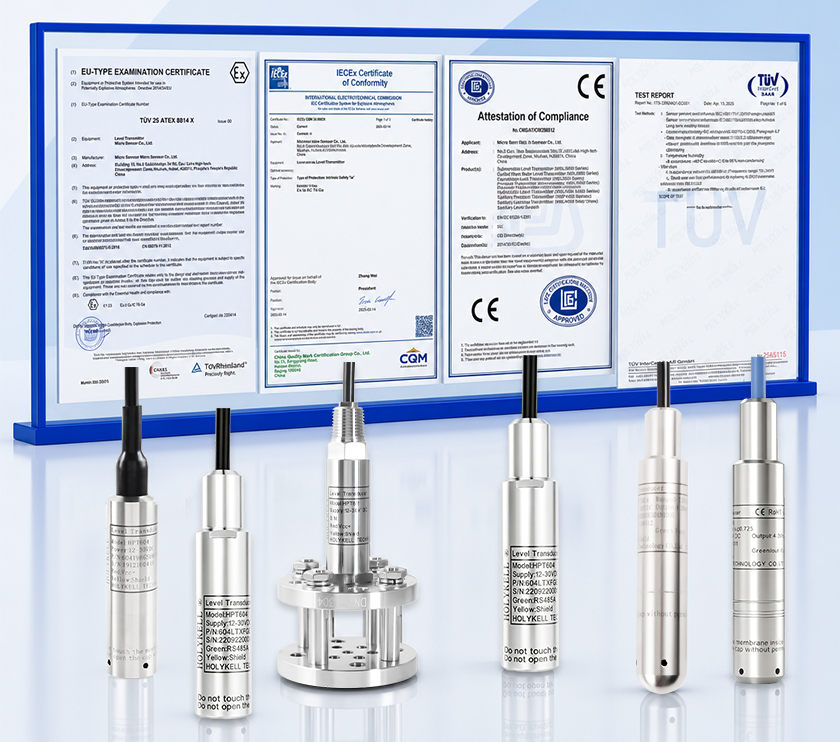
Holykell offers various certifications, especially TÜV issued dual ATEX/IECEx certificates.
Conclusion
Certifications are an important factor when selecting a level sensor, especially for industrial applications. The right certification ensures that the product can operate safely, meet local regulations, and pass project approval.
Before purchasing a level transmitter, always choose certifications based on your application environment, installation location, and local regulations, rather than simply selecting the product with the most certificates.
FAQ
1. Should I choose a level sensor with more certifications?
More certifications do not always mean a better product. The required certifications depend on the application, installation environment, and target market. Choosing unnecessary certifications may increase cost without providing additional value.
2. How can I know which certifications are required for my project?
First, identify three factors:
- Where will the level sensor be installed?
- Does it contact the measured medium?
- Is the installation area hazardous?
3. Are certifications the same for all types of level sensors?
No. Certification requirements can vary depending on the measurement technology.
For example: Submersible level sensors may require IP68 and water contact certifications.
Radar and ultrasonic level sensors usually focus on electrical safety, EMC, and environmental protection certifications.
4. Do certifications affect the price of a level transmitter?
Yes. Additional certifications usually require extra testing, documentation, and production control, which may increase product cost.
However, selecting the correct certification package based on your application can help balance compliance requirements and project budget.
5. How often should level sensor certifications be updated?
Certification validity depends on the certification type and product changes. If a manufacturer changes product design, materials, electronics, or production processes, certification updates may be required.
About the Author
Li Fei is a Senior Engineer at HOLYKELL, specializing in industrial level measurement solutions, including submersible level sensors, radar level transmitters, and wireless monitoring systems. With years of experience in sensor design and industrial applications, he helps customers select reliable measurement solutions for water, oil, chemical, and automation industries.