
How to Select an Explosion-Proof Level Transmitter for Chemical Tanks
TL;DR
To select an explosion-proof level transmitter for chemical tanks, ensure it is certified for your hazardous area classification (Zone 0/1/2) under ATEX and/or IECEx based on IEC 60079 standards. For global chemical plants, dual-certified equipment (ATEX + IECEx), especially from a recognized Notified Body such as TÜV, provides the safest and most cost-efficient compliance pathway.
Key Selection Factors for Explosion-Proof Level Transmitters
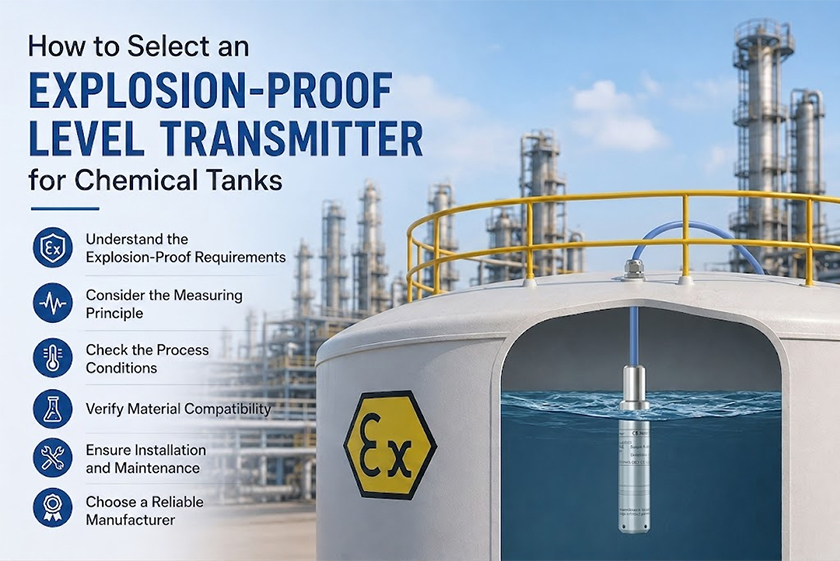
When choosing a level transmitter for chemical tanks, safety certification is only one part of the decision. Industrial buyers should evaluate both hazardous area compliance and process compatibility.
1. Hazardous Area Classification
Identify tank location: Zone 0, Zone 1, or Zone 2
Confirm gas group: IIA / IIB / IIC (chemical severity level)
Verify temperature class (T1–T6)
2. Explosion Protection Certification
ATEX for EU compliance
IECEx for international acceptance
Dual certification preferred for global EPC projects
3. Measurement Technology Type
Radar level transmitter (preferred for chemical tanks with vapor, foam, or pressure changes)
Guided wave radar (good for small tanks or internal structures)
Ultrasonic (cost-effective but limited in harsh chemical environments)
4. Chemical Compatibility
Wetted parts material: PTFE, PVDF, or 316L stainless steel
Corrosion resistance for acids, alkalis, solvents
5. Installation Conditions
Tank pressure and temperature
Agitation or turbulence inside tank
Foam, vapor, or condensation interference
ATEX vs IECEx in Chemical Tank Applications
Both certification systems are based on IEC 60079 standards, but they serve different compliance needs.
ATEX (EU Requirement)
Mandatory in the European Union
Requires CE marking
Based on Directive 2014/34/EU
Used for legal market access in Europe
IECEx (Global System)
Accepted in many international projects
No CE marking required
Strong in oil & gas, chemical export markets
Often requested in EPC specifications
Why Dual Certification Matters
For chemical plants serving multiple regions, dual certification avoids redesigning procurement specifications for different countries and reduces approval delays during audits and commissioning.
Certification Body Comparison (Why It Matters)
Not all certifications carry the same engineering credibility in industrial projects.
| Factor | TÜV SÜD | ECM (Example Notified Body) |
|---|---|---|
| EU Notified Body Status | Yes (CE 0123) | Yes |
| Global Recognition | Very high | Medium |
| EPC Contractor Acceptance | Widely accepted | Project dependent |
| Chemical Industry Trust Level | High | Moderate |
| Audit & Documentation Confidence | Strong | Varies |
In hazardous chemical environments, many EPC contractors prefer certifications issued by globally recognized bodies like TÜV SÜD because they reduce engineering approval risks and documentation disputes.
Explosion-Proof Certification Parameters (Typical Example)
Below is a typical configuration for a chemical tank level transmitter:
| Parameter | ATEX | IECEx |
|---|---|---|
| Certificate Type | ATEX Certificate | IECEx Certificate |
| Marking | Ex II 1G Ex ia IIC T4 Ga | Ex ia IIC T4 Ga |
| Equipment Group | II (surface industries) | II |
| Protection Method | Intrinsic Safety (Ex ia) | Intrinsic Safety (Ex ia) |
| Gas Group | IIC (most explosive gases) | IIC |
| Temperature Class | T4 | T4 |
| Protection Level | Ga (Zone 0 capable) | Ga |
| Applicable Zones | Zone 0 / 1 / 2 | Zone 0 / 1 / 2 |
| Standard | EN IEC 60079 series | IEC 60079 series |
Important: Always match Ex marking with actual tank classification. A mismatch can invalidate system safety approval.
Real User Scenario: Chemical Tank Farm Upgrade
A chemical plant operating in Europe and Southeast Asia needed to upgrade level measurement systems across 48 storage tanks containing acids and solvents.
Initial Challenge
ATEX-only devices worked in EU facilities
IECEx preference appeared in overseas plants
Engineering team faced duplicated BOMs and certification documents
Risks Identified
Different transmitter models for different regions
Higher spare part inventory cost
Delayed procurement approvals
Compliance confusion during audits
Final Solution
The plant selected dual-certified level transmitters certified under both ATEX and IECEx through TÜV SÜD.
Results
One unified product specification globally
Reduced procurement complexity
Faster engineering approval cycle
Simplified maintenance and spare parts management
Lower lifecycle compliance risk
This approach is now commonly used in chemical, wastewater, hydrogen, and pharmaceutical tank applications.
FAQ
1. What is the best level transmitter type for chemical tanks?
Level transmitters are generally used according to the working applications. Different sensors work fine in different cases. Consider the temperature, medium, vapor, condensation and other factors.
2. Do I need both ATEX and IECEx certifications?
If your project is limited to the EU, ATEX is sufficient. For global chemical plants or EPC projects, dual certification is recommended to avoid redesigning compliance documentation.
3. Why is the certification body important?
The credibility of the Notified Body affects project approval speed. Certifications from internationally recognized organizations such as TÜV SÜD are more widely accepted in chemical and oil & gas industries.
Conclusion
Selecting an explosion-proof level transmitter for chemical tanks requires balancing hazardous area safety, measurement reliability, and global certification compliance. ATEX ensures legal access in Europe, while IECEx supports international deployment across chemical industries worldwide.
For global chemical tank projects, dual-certified equipment significantly reduces engineering complexity and compliance risk. In particular, instruments certified by TÜV SÜD provide higher acceptance in EPC and audit processes due to strong international recognition.
A coordinated certification approach can also reduce testing duplication, saving up to 40% certification cost and 50% approval time compared to separate certification paths.
Get our step-by-step certification checklist to evaluate explosion-proof level transmitters and ensure full compliance for your chemical tank applications.