
How to Select a Radar Level Sensor?
Introduction
Radar level sensors have become one of the most reliable technologies for continuous level measurement in industrial applications. Compared with ultrasonic, float, or hydrostatic sensors, radar sensors provide higher accuracy, longer measuring distances, and excellent performance in harsh environments such as dust, steam, condensation, and high temperatures.
However, selecting the right radar level sensor is not always straightforward. Different radar technologies are designed for different applications, and factors such as the measured medium, tank structure, installation conditions, and required accuracy all influence the selection.
This guide explains the different types of radar level sensors and provides practical advice to help you choose the most suitable solution for your application.
What Are the Main Types of Radar Level Sensors?
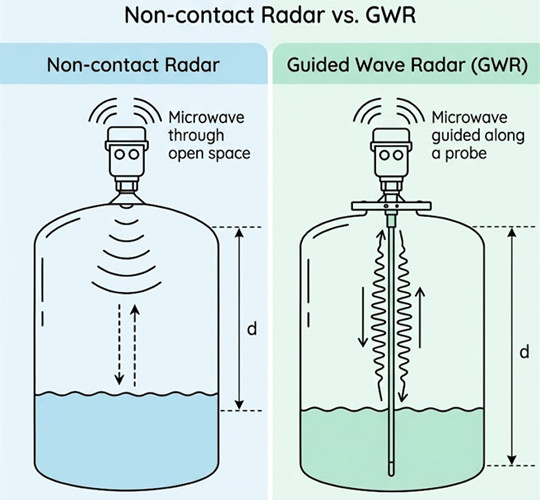
Radar level sensors can be divided into two main categories: Non-contact Radar Level Sensors and Guided Wave Radar (GWR). Both technologies use microwave signals to measure level, but they differ in how the signals travel and interact with the measured medium.
Non-contact Radar Level Sensors
Non-contact radar sensors transmit microwave signals through free space toward the material surface. The reflected signal is analyzed to calculate the level.
Common operating frequencies include:
26GHz
60GHz
80GHz
Among these, 60GHz and 80GHz have become the mainstream choices because they offer better focusing ability, improved signal processing, and higher measurement reliability than earlier 26GHz designs.
<
Guided Wave Radar (GWR)
Guided wave radar sensor also uses microwave technology, but instead of transmitting signals through the air, the microwave pulse travels along a probe (rod, cable, or coaxial tube). The signal reflects when it reaches the product surface, allowing the instrument to determine the level.
This design provides stable measurement in applications where the signal benefits from being guided directly to the medium.
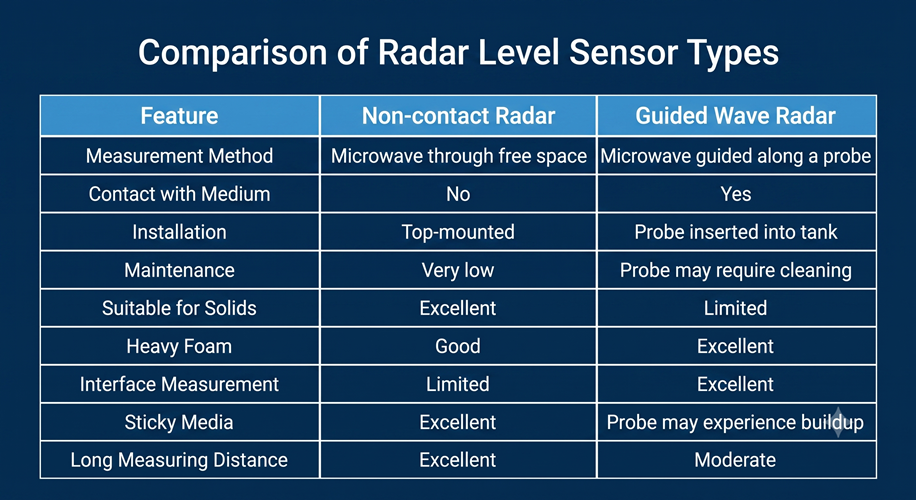
Comparison of Radar Level Sensor Types
<
How to Select a Radar Level Sensor
Choosing the right radar level sensor depends on several key factors.
1. What Medium Are You Measuring?
The type of material is the first consideration. For liquids, such as water, wastewater, chemicals, fuels, and edible oils, both non-contact radar and guided wave radar can provide reliable measurement.
For bulk solids, including grain, cement, fly ash, sand, coal powder, and plastic pellets, non-contact radar is generally the preferred choice because it measures without contacting the material and performs well in dusty environments.
2. Consider Tank Size and Measuring Distance
Tank dimensions influence both installation and performance.
|
Tank Type |
Recommended Technology |
|
Water Storage Tank |
Non-contact Radar |
|
Chemical Tank |
Non-contact Radar or Guided Wave Radar |
|
Fuel Storage Tank |
Non-contact Radar |
|
Grain Silo |
Non-contact Radar |
|
Cement Silo |
Non-contact Radar |
|
Small Process Vessel |
Guided Wave Radar |
|
Bypass Chamber |
Guided Wave Radar |
Large storage tanks and silos usually benefit from non-contact radar, while guided wave radar is often suitable for compact process vessels.
3. Evaluate Process Conditions
Environmental conditions can significantly affect measurement performance. Choose non-contact radar when the application involves:
Dust
Steam
Condensation
Corrosive media
Sticky products
Internal obstacles such as agitators or ladders
Choose guided wave radar when the application involves:
Heavy foam
Interface measurement between two liquids
Small vessels with stable installation conditions
4. Consider Maintenance Requirements
Maintenance costs should be evaluated over the entire service life of the instrument.
Non-contact radar offers several advantages:
No contact with the measured medium
No moving parts
Minimal maintenance
Long operating life
Guided wave radar may require periodic probe cleaning if product buildup occurs.
When Should You Choose 80GHz Instead of 60GHz?
Both 60GHz and 80GHz radar technologies deliver excellent performance for industrial level measurement. However, their strengths differ depending on the application. Choose an 80GHz radar sensor if your application involves:
Bulk solids such as grain, cement, fly ash, sand, or plastic pellets
Narrow nozzles or confined installation spaces
Long measuring distances
Dusty environments
Tanks with internal structures that may cause signal interference
Applications requiring very high measurement accuracy
The higher operating frequency enables a narrower beam angle, allowing the radar signal to better avoid tank walls and internal obstacles.
A 60GHz radar sensor is often sufficient for:
Water storage tanks
Municipal water systems
Wastewater treatment
Diesel and fuel tanks
Chemical storage tanks with simple geometry
General industrial liquid level measurement
For many standard liquid applications, a 60GHz radar sensor provides an excellent balance between performance and cost.
Recommended Radar Technology by Application
|
Application |
Recommended Technology |
Suggested Frequency |
|
Clean Water Tanks |
Non-contact Radar |
60GHz or 80GHz |
|
Wastewater Tanks |
Non-contact Radar |
60GHz or 80GHz |
|
Fuel Storage Tanks |
Non-contact Radar |
60GHz or 80GHz |
|
Chemical Storage Tanks |
Non-contact Radar |
60GHz or 80GHz (depending on installation) |
|
Grain Silos |
Non-contact Radar |
80GHz |
|
Cement Silos |
Non-contact Radar |
80GHz |
|
Plastic Pellets |
Non-contact Radar |
80GHz |
|
Fly Ash Silos |
Non-contact Radar |
80GHz |
|
Interface Measurement |
Guided Wave Radar |
N/A |
|
Heavy Foam Liquids |
Guided Wave Radar |
N/A |
|
Small Process Vessels |
Guided Wave Radar |
N/A |
|
Bypass Chambers |
Guided Wave Radar |
N/A |
Conclusion
Selecting the right radar level sensor starts with understanding your application rather than choosing the highest frequency available.
For most industrial liquid level applications, non-contact radar operating at 60GHz or 80GHz provides reliable, maintenance-free measurement with excellent long-term stability.
If your application involves bulk solids, narrow installation spaces, dusty conditions, or requires higher measurement precision, 80GHz radar is often the preferred choice due to its narrower beam angle and superior signal focusing.
For interface measurement, heavy foam, or compact process vessels where a probe-guided signal offers advantages, guided wave radar remains an excellent solution.
By evaluating your medium, tank geometry, process conditions, and maintenance expectations, you can select a radar level sensor that delivers accurate and dependable performance throughout its service life.
Radar Level Sensor FAQs
1. Is 80GHz radar always better than 60GHz radar?
Not necessarily. For many standard liquid applications, 60GHz radar provides excellent performance. An 80GHz radar sensor is particularly advantageous for bulk solids, narrow installation spaces, dusty environments, and applications requiring a narrower beam angle or higher accuracy.
2. Which radar technology is best for grain silos?
Non-contact radar is generally the preferred solution. An 80GHz radar sensor is especially suitable because its narrow beam angle helps reduce interference from silo walls and internal structures.
3. Can radar level sensors measure corrosive liquids?
Yes. Non-contact radar is especially well suited because it does not come into contact with the measured medium.
4. What’s the difference between a radar level sensor and an ultrasonic level sensor?
See our previous article here.
5. Can one radar level sensor be used for both liquids and solids?
Yes. Many radar level sensors can measure both liquids and solids. However, the sensor configuration may differ depending on the application. Solid materials such as grain, cement, and coal usually require a sensor with a narrow beam angle, strong signal processing capability, and longer measuring range.
6. Does the dielectric constant of the medium affect radar measurement?
Yes. The dielectric constant affects the strength of the reflected radar signal. Materials with a high dielectric constant, such as water-based liquids, reflect radar signals strongly and are easier to measure.
Low dielectric materials, such as plastic pellets, oil, and some powders, require optimized radar technology and installation.
7. Can radar level sensors work in tanks with mixers or agitators?
Yes, but proper selection and installation are important.
8. Do radar level sensors require calibration?
Yes, but radar sensors usually require minimal calibration compared with other technologies.