
How to Monitor Fuel Tank Level Remotely?
TL;DR: Remote Fuel Tank Monitoring Explained
A remote fuel tank monitoring system uses a fuel level sensor, wireless communication (4G, NB-IoT, LoRa, or LoRaWAN), and a monitoring platform to transmit fuel data remotely. Depending on the application, users can choose integrated wireless sensors or traditional sensors connected through wireless gateways.
Based on our application experience, below are the most frequently asked questions from our customers:
- How can I check fuel levels remotely?
- How can I prevent fuel theft?
- Can I monitor multiple tanks from one platform?
- Can the system connect to my own IoT platform?
What Is Remote Fuel Tank Level Monitoring?
A remote fuel monitoring system measures the fuel level inside a tank and sends the data to a remote platform through wireless communication.
Unlike traditional manual inspection, users can check:
- Current fuel level
- Historical consumption data
- Low fuel alarms
- Abnormal level changes
- Tank location information
A typical system includes four parts:
Fuel Level Sensor → Wireless Communication → Cloud Platform → Mobile/PC Dashboard
| Component | Function |
|---|---|
| Fuel Level Sensor | Measures fuel height or volume |
| Communication Module | Transfers data through 4G, NB-IoT, LoRa, etc. |
| GPS Module (Optional) | Provides tank or vehicle location |
| Cloud Platform | Stores data and provides monitoring tools |
Why Remote Fuel Monitoring?
1. Reduce Manual Checks
For remote tanks or distributed fuel assets, checking every tank manually requires time and labor.
Remote monitoring allows operators to view fuel levels without traveling to each location.
Typical applications include:
- Multiple diesel tanks
- Remote construction sites
- Agricultural irrigation equipment
- Mining vehicles
2. Prevent Fuel Theft and Abnormal Consumption
Fuel theft is a common concern for fleet operators and fuel storage users. By monitoring real-time fuel level changes, the system can detect:
- Sudden fuel drops
- Unexpected consumption
- Unauthorized refueling
Users can receive alerts and take action quickly.
3. Improve Fuel Inventory Management
For fuel distributors and industrial users, accurate inventory information helps optimize refueling schedules.
Instead of waiting until a tank is almost empty, operators can:
- Plan fuel delivery in advance
- Avoid equipment downtime
- Reduce unnecessary site visits
Remote tank monitoring solutions commonly combine level data with cloud dashboards and alerts to improve inventory visibility.
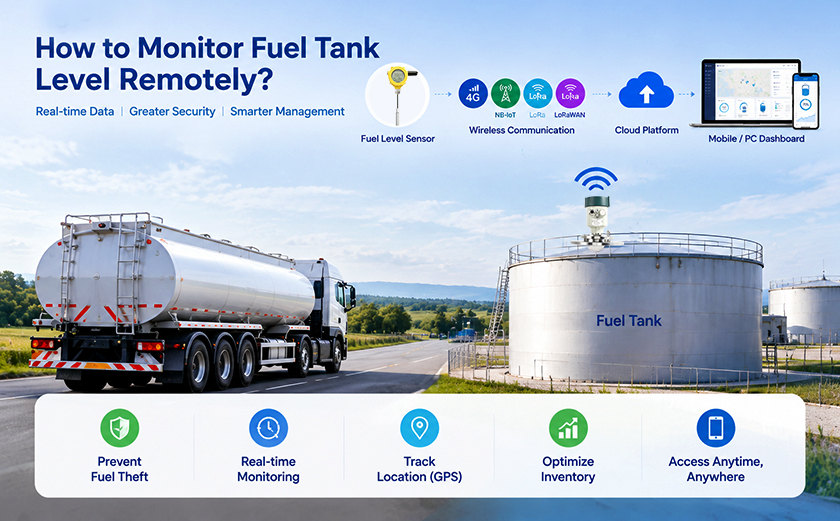
How Does a Remote Fuel Monitoring System Work?
The working process is simple:
Fuel Level Measurement → Sensor Collects Data → Wireless Transmission → Cloud Platform → Mobile App / Customer System
For example:
A fuel tank level sensor installed on a truck measures diesel level. The data is transmitted through:
- 4G
- NB-IoT
- LoRaWAN
- LoRa
Then users can view fuel status through:
- Web platform
- Mobile APP
- Their own IoT system through API/MQTT
Choosing the Right Communication Method
Different applications require different wireless technologies.
| Communication | Best For | Advantages |
|---|---|---|
| 4G | Vehicles, remote areas | Wide coverage, direct connection |
| NB-IoT | Fixed tanks, low-frequency monitoring | Low power consumption |
| LoRa / LoRaWAN | Large areas with multiple tanks | Long range, low cost networking |
| WiFi | Indoor or factory environments | Easy integration |
How to Choose a Remote Fuel Monitoring Solution?
| Requirement | Recommended Solution |
|---|---|
| Truck fuel monitoring | Capacitive fuel sensor + GPS + 4G |
| Remote diesel tank without power | Battery-powered wireless sensor |
| Multiple tanks in one area | LoRa/LoRaWAN solution |
| Existing monitoring system | Sensor + wireless gateway |
| Hazardous fuel area | Explosion-proof level sensor |
Do You Need GPS for Fuel Monitoring?
GPS is not required for every application. The choice depends on your application.
| Application | GPS Requirement |
|---|---|
| Fuel tanker trucks | Recommended |
| Fleet management | Recommended |
| Fixed diesel tanks | Optional |
| Factory storage tanks | Usually unnecessary |
For vehicles, GPS helps users monitor:
- Tank location
- Vehicle position
- Fuel consumption according to route
For fixed tanks, level data is usually the main requirement.
Do You Need a Cloud Platform?
A cloud platform is optional. There are two common solutions:
Solution 1: Sensor + Cloud Platform
Suitable for customers who need:
- Ready-to-use monitoring system
- Mobile APP
- Alarm notification
- Multiple device management
Solution 2: Sensor + Customer Platform Integration
Suitable for companies with existing IoT systems.
The sensor can transmit data through:
- MQTT
- HTTP
- Modbus
- API interface
Customers can integrate fuel level data into their own software.
Selecting the Right Fuel Level Sensor
Different tanks require different sensor technologies.
| Sensor Type | Suitable Applications | Advantages |
|---|---|---|
| Capacitive Fuel Level Sensor | Fuel tanks, vehicles, diesel tanks | Compact design, easy installation, suitable for diesel and oil measurement |
| Submersible Level Sensor | Underground tanks, deep tanks, fuel storage tanks | Measures liquid pressure directly, suitable for various tank depths |
| Radar Level Sensor | Large storage tanks, industrial fuel tanks | Non-contact measurement, suitable for challenging environments |
| Ultrasonic Level Sensor | Open tanks, above-ground fuel tanks, general liquid storage | Non-contact measurement, easy installation, no contact with fuel |
| Wireless Level Sensor | Remote tanks, distributed fuel assets, unattended locations | Wireless data transmission, remote monitoring, reduced wiring and installation costs |
When selecting a sensor, consider:
- Fuel type
- Tank shape
- Measurement range
- Installation method
- Explosion-proof requirements
- Communication method
Typical Applications of Remote Fuel Monitoring
| Application | Challenges | Recommended Solution | Key Benefits |
|---|---|---|---|
| Fleet Fuel Management | Multiple trucks require fuel level tracking and theft prevention | Fuel level sensor + GPS + 4G communication |
|
| Remote Diesel Storage Tanks | Tanks are located in remote areas and require frequent manual inspection | Wireless fuel level monitoring system |
|
| Construction and Mining Sites | Fuel equipment operates in remote locations without easy access to power or network infrastructure | Battery-powered wireless fuel monitoring solution |
|
Conclusion
A remote fuel monitoring system is not only a fuel level sensor. It is a complete solution combining:
- Accurate level measurement
- Wireless communication
- GPS tracking (optional)
- Cloud monitoring
- Data integration
The best solution depends on your application:
- Mobile vehicles → Fuel sensor + 4G + GPS
- Remote tanks → Wireless sensor + IoT platform
- Industrial systems → Sensor + customer platform integration
By selecting the right sensor and communication method, companies can reduce manual inspections, improve fuel management efficiency, and gain better visibility of their fuel assets.
Holykell Wireless Fuel Level Monitoring Solutions
For different fuel monitoring applications, HOLYKELL provides flexible wireless solutions to help customers achieve remote fuel level monitoring without complicated wiring.
Depending on the installation environment and system requirements, customers can choose from two wireless monitoring approaches:
Solution 1: Integrated Wireless Fuel Level Sensor
The integrated wireless fuel level sensor combines level measurement and wireless communication in one device.
It can directly transmit fuel level data through different wireless networks.
| Feature | Benefit |
|---|---|
| Integrated sensor design | Easy installation with fewer components |
| Multiple wireless options | Suitable for different network environments |
| Battery-powered operation | Ideal for remote and unattended locations |
| Direct cloud connectivity | Real-time monitoring and alarm management |
Solution 2: Standard Level Sensor + Wireless Gateway
For customers who already have level sensors or require flexible system integration, HOLYKELL also provides a gateway-based wireless monitoring solution.
In this solution, a traditional wired level sensor is connected to a wireless gateway, which transfers the measurement data through different communication networks.
| Feature | Benefit |
|---|---|
| Compatible with existing sensors | Easy upgrade of current monitoring systems |
| Flexible sensor selection | Supports pressure, radar, ultrasonic and other level technologies |
| Multiple communication options | Adapt to different project requirements |
| Easy system expansion | Suitable for multiple tanks and large projects |
Which Wireless Fuel Monitoring Solution Should You Choose?
| Application Requirement | Recommended Solution |
|---|---|
| Need a simple all-in-one monitoring device | Integrated Wireless Fuel Level Sensor |
| Remote tank without wired infrastructure | Integrated Wireless Sensor |
| Already have level sensors installed | Level Sensor + Wireless Gateway |
| Need to connect multiple sensor types | Wireless Gateway Solution |
| Need integration with existing IoT platform | Either solution with MQTT / HTTP / API support |
FAQ
Can I monitor fuel tank level from my phone?
Yes. With a wireless fuel level sensor connected to a cloud platform, users can check fuel level data and receive alarms through mobile devices.
Does a fuel monitoring system require GPS?
No. GPS is mainly needed for vehicles or movable fuel assets. Fixed tanks usually only require level monitoring.
Can the fuel sensor connect to my own IoT platform?
Yes. Many industrial fuel level sensors support MQTT, HTTP, Modbus, or API integration.
Which communication is best for remote fuel tanks?
It depends on location and application. 4G is suitable for wide coverage, while NB-IoT and LoRaWAN are suitable for low-power fixed installations.
How can remote fuel monitoring prevent fuel theft?
By tracking sudden fuel level changes and sending abnormal alerts, users can identify possible unauthorized fuel loss.
About Author
Li Fei is a Senior Engineer at HOLYKELL, focusing on industrial sensing solutions including fuel level monitoring, pressure measurement, and IoT-based remote monitoring systems.
With years of experience helping customers select sensors for transportation, energy, and industrial applications, Li Fei shares practical knowledge about measurement technologies and application solutions.