How to Measure Water Tank Level? A Practical Guide for Choosing the Right Level Sensor
Sep 16 , 2026
Table of Contents
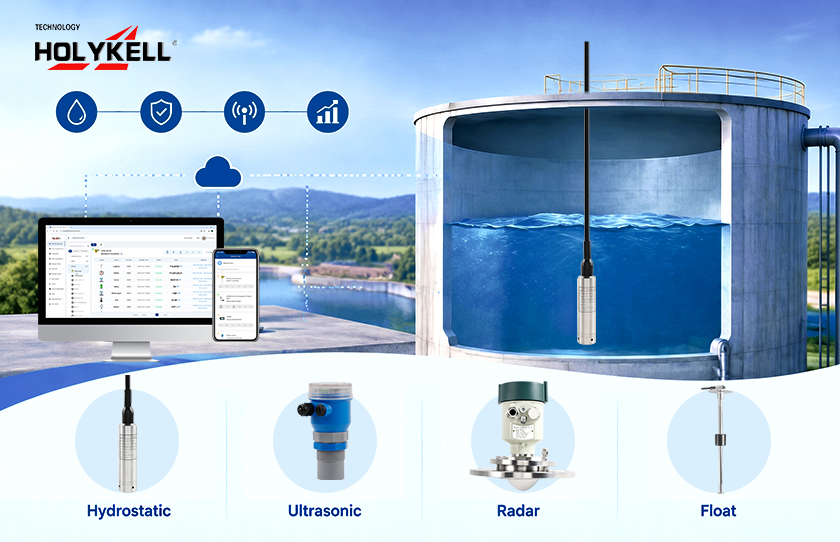
Water tank level can be measured by several technologies, including hydrostatic pressure sensors, ultrasonic level sensors, radar level sensors, and float level switches.
The best measurement method depends on factors such as:
- Tank type and installation environment
- Liquid characteristics
- Measurement range
- Required accuracy
- Temperature and pressure conditions
- Communication requirements
For most water storage applications, hydrostatic level sensors and ultrasonic level sensors are the most commonly used solutions, while radar technology is preferred for harsh environments requiring higher accuracy and reliability.
A proper water tank level measurement system helps users monitor water volume, prevent overflow, avoid dry running of pumps, and improve water management efficiency.
Why Measure Water Tank Level?
Water storage tanks are widely used in residential, commercial, agricultural, municipal, and industrial applications. Without accurate level monitoring, users may face problems such as:
- Unexpected water shortages
- Tank overflow and water waste
- Pump dry running and equipment damage
- Manual inspection costs
- Inefficient water management
By installing a water level measurement system, operators can:
- Monitor water level remotely
- Automatically control pumps and valves
- Receive high and low level alarms
- Optimize water usage
- Improve operational safety
For example:
- A municipal water system needs continuous monitoring of reservoir and storage tank levels.
- An irrigation system needs accurate water level data to optimize water supply.
- An industrial water tank requires reliable measurement to maintain production processes.
- A water treatment plant needs stable level control for tanks and pools.
What Are the Common Methods to Measure Water Tank Level?
There are four main methods for measuring water tank level:
| Measurement Method |
Principle |
Advantages |
Typical Applications |
| Hydrostatic Level Sensor |
Measures liquid pressure caused by water depth |
Accurate, reliable, cost-effective |
Water tanks, wells, reservoirs |
| Ultrasonic Level Sensor |
Measures distance using ultrasonic waves |
Non-contact measurement |
Open tanks, wastewater tanks |
| Radar Level Sensor |
Uses microwave signals to measure distance |
High accuracy, works in harsh environments |
Industrial tanks, large tanks |
| Float Level Sensor |
Uses mechanical float position |
Simple and low cost |
Basic level control |
1. Hydrostatic Water Tank Level Measurement
How Does a Hydrostatic Level Sensor Work?
A hydrostatic water level sensor measures liquid level by detecting the pressure generated by the water column. The deeper the sensor is installed, the higher the pressure it detects.
The relationship is:
Pressure = Liquid Density × Gravity × Height
(P = ρgh)
The sensor converts pressure into an electrical signal, such as:
- 4-20mA
- 0-10V
- RS485 Modbus
- HART
The signal can then be transmitted to a PLC, controller, IoT gateway, or monitoring platform.
Advantages of Hydrostatic Measurement
- ✔ High accuracy
- ✔ Suitable for deep water measurement
- ✔ Works in closed or open tanks
- ✔ Stable performance in outdoor environments
- ✔ Cost-effective for continuous monitoring
Typical Applications
- Water storage tanks
- Underground water tanks
- Deep wells
- Reservoir monitoring
- Irrigation systems
- Municipal water supply
2. Ultrasonic Water Tank Level Measurement
How Does an Ultrasonic Level Sensor Work?
An ultrasonic level sensor measures the distance between the sensor and the water surface. The sensor sends ultrasonic waves downward. When the signal reaches the water surface, it reflects back to the sensor.
The level is calculated based on:
Tank Height – Measured Distance = Water Level
Advantages
- Non-contact measurement
- No sensor contact with liquid
- Easy installation
- Suitable for corrosive liquids
Limitations
Ultrasonic measurement may be affected by:
- Foam
- Vapor
- Temperature changes
- Dust
- Uneven surfaces
Typical applications include:
- Open water tanks
- Wastewater tanks
- Chemical tanks
- Small storage tanks
3. Radar Water Tank Level Measurement
How Does Radar Level Measurement Work?
Radar level sensors use electromagnetic waves to measure the distance between the sensor and liquid surface.
Advantages of Radar Level Sensors
- Non-contact measurement
- High accuracy (millimeter-level)
- Suitable for extreme temperatures
- Not affected by vapor or pressure changes
- Works well in large tanks and industrial environments
Radar level measurement is commonly used for:
- Large industrial water tanks
- Chemical storage tanks
- Water treatment plants
- High-temperature applications
4. Float Water Level Measurement
How Does a Float Level Sensor Work?
A float level sensor uses a floating device that moves according to the liquid level. When the water level changes, the float moves up or down and triggers a switch signal.
Advantages
- Simple structure
- Low cost
- Easy installation
Limitations
Compared with electronic sensors:
- Lower accuracy
- Limited monitoring distance
- No continuous remote data transmission
Float switches are mainly used for:
- Pump start/stop control
- Simple high/low level alarms
- Small water tanks
Hydrostatic vs Ultrasonic vs Radar vs Float: Which Is Better?
| Feature |
Hydrostatic |
Ultrasonic |
Radar |
Float |
| Contact Measurement |
Yes |
No |
No |
Yes |
| Accuracy |
High |
Medium |
Very High |
Low |
| Long Distance Measurement |
Excellent |
Medium |
Excellent |
Poor |
| Outdoor Use |
Excellent |
Medium |
Excellent |
Good |
| Affected by Foam/Vapor |
Low |
High |
Very Low |
Medium |
| Remote Monitoring |
Yes |
Yes |
Yes |
Limited |
| Cost |
Medium |
Medium |
Higher |
Low |
How to Choose the Right Water Tank Level Sensor?
Choosing the correct sensor requires considering the following factors.
1. Tank Type
| Water Tank Type |
Best Level Sensor Choice |
Reason |
| Closed Water Tank |
Submersible or Radar |
Choose hydrostatic sensors for cost-effective continuous measurement. Choose radar sensors when non-contact measurement or higher accuracy is required. |
| Open Water Tank |
Submersible, Ultrasonic, or Radar |
Open tanks allow flexible installation. Hydrostatic sensors work well for long-term monitoring, while ultrasonic and radar provide non-contact measurement. |
| Underground Water Tank |
Submersible |
The sensor can be installed at the bottom of the tank to directly measure water pressure and provide accurate level data even in hidden locations. |
2. Measurement Range
Select the sensor range according to the maximum water depth.
Example: For a 5-meter tank:
Recommended: 0-5m sensor range or 0-10m sensor range
Avoid selecting a range that is too large because it may reduce measurement resolution.
3. Accuracy Requirement
For general water monitoring, ±0.5%FS accuracy is usually sufficient.
For industrial processes requiring precise control, ±0.25%FS or higher accuracy may be required.
4. Communication Method
Modern water management systems often require remote monitoring. Common outputs include:
- 4-20mA
- RS485 Modbus
- HART
- LoRaWAN
- NB-IoT
- 4G
For IoT applications, a water level sensor can connect to a gateway and upload real-time data to a cloud platform.
Water Tank Level Measurement Solutions for Different Applications
| Water Measurement Application |
Recommended Method |
Typical Use Cases |
| Water Tanks & Storage Tanks |
Hydrostatic / Ultrasonic / Radar Level Sensor |
Drinking water tanks, rooftop tanks, underground tanks, industrial storage tanks |
| Wells & Groundwater |
Submersible Level Sensor |
Groundwater wells, monitoring wells, boreholes, environmental monitoring |
| Reservoirs, Rivers & Surface Water |
Submersible / Radar / Ultrasonic Level Sensor |
Reservoirs, rivers, lakes, flood warning systems |
| Water Treatment & Wastewater Systems |
Hydrostatic Level Sensor / Radar Level Sensor |
Clarifiers, sedimentation tanks, filter tanks, sewage tanks |
| Agricultural Irrigation Systems |
Submersible / Wireless |
Irrigation ponds, farm water tanks, agricultural reservoirs |
| Industrial Process Water Systems |
Radar / Submersible Level Sensor |
Cooling water tanks, boiler feed water tanks, process water tanks |
Why Choose HOLYKELL Water Level Sensors?
With more than 20 years of experience in sensor technology, HOLYKELL develops reliable measurement products including:
- Submersible water level sensors
- Radar level transmitters
- Ultrasonic level sensors
- Wireless IoT monitoring solutions
Recommended HOLYKELL Water Level Sensors
HPT604 Submersible Water Level Sensor
Application:
- Water tanks
- Wells
- Reservoirs
- Irrigation
- Rivers
- Deep wells
Key Features:
- Range: 0.5–500m
- Accuracy: ±0.1%FS / ±0.25%FS / ±0.5%FS
- Output: 4-20mA, RS485 Modbus, HART, 0-5 V, 0.5-4.5V, SDI12
- Protection: IP68
Frequently Asked Questions
What is the most accurate way to measure water tank level?
Radar level sensors generally provide the highest accuracy, especially for large industrial tanks. For most water tanks, hydrostatic level sensors provide excellent accuracy with a more economical solution.
Can I measure water level remotely?
Yes. Water level sensors with RS485, LoRaWAN, NB-IoT, or 4G communication can transmit level data to remote monitoring platforms.
Which sensor is best for underground water tanks?
A submersible hydrostatic level sensor is usually the best choice because it can be installed directly inside the tank and provides stable continuous measurement.
How deep can a water level sensor measure?
The measurement range depends on the sensor model. Industrial submersible level sensors can typically measure from several meters to hundreds of meters.
What is the difference between water level sensor and water level switch?
A water level sensor provides continuous level measurement, while a level switch only detects specific points such as high or low level.
About the Author
Senior Engineer at Holykell
Li Fei serves as a Senior Engineer at Holykell, with extensive experience in industrial measurement technologies and smart monitoring solutions. Over the past 15 years, he has focused on the development and application of pressure measurement, level sensing, and Industrial IoT technologies, providing reliable sensing solutions for customers in various industries worldwide.
Throughout his career, Li Fei has participated in hundreds of customized projects involving water and wastewater management, oil and gas applications, chemical processing, agricultural monitoring, and industrial automation. His expertise includes selecting suitable level and pressure instruments, building remote monitoring platforms, and optimizing sensor systems for challenging operating environments.
He has contributed to the design of intelligent monitoring solutions for applications such as remote water resources, fuel storage facilities, industrial tanks, and automated equipment. His work focuses on improving measurement accuracy, communication reliability, and system stability through advanced sensor technologies and wireless data transmission solutions.
Li Fei holds a Bachelor’s degree in Automation Engineering. Through continuous innovation and practical application experience, he helps global customers achieve more efficient operations, smarter asset management, and digital transformation.