
Global Wireless Level Monitoring Market Trends
Chapter 1: Global Market Overview
1.1 Core Market Data and Growth Rate
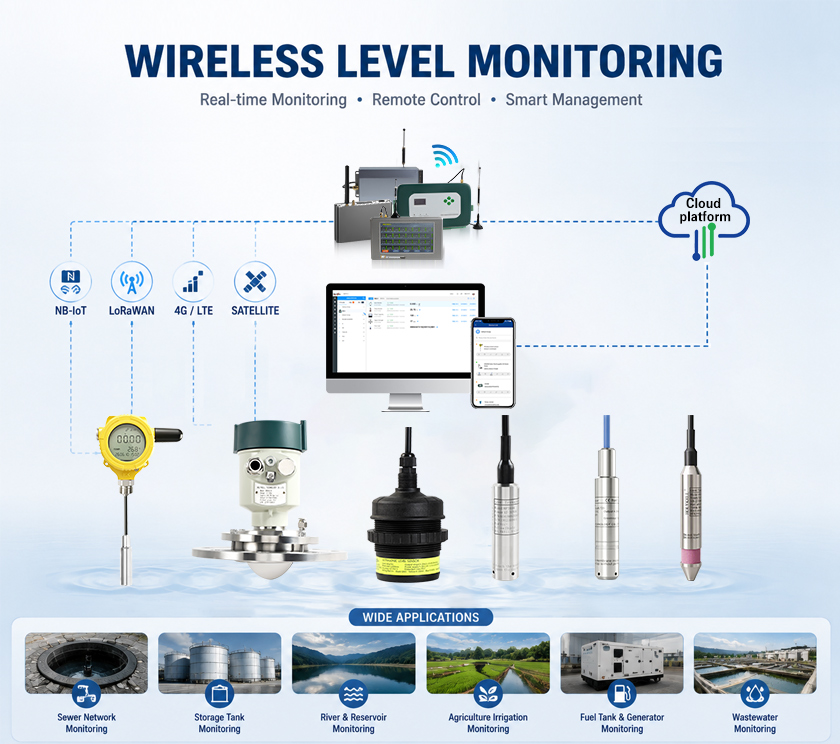
Entering 2026, the global Wireless Level Monitoring and Remote Tank Monitoring (RTM) system market is evolving from simple “sensor data collection” toward an integrated end-to-end cloud intelligent monitoring ecosystem.
According to the latest revised data from The Business Research Company and Knowledge Sourcing Intelligence:
Global Market Size in 2026
The global market size of wireless level monitoring and remote tank monitoring hardware and systems is expected to reach USD 1.24 billion.The overall related software and data service (SaaS) ecosystem is expected to exceed USD 3.8 billion.
Compound Annual Growth Rate (CAGR)
From 2026 to 2030, the market is expected to maintain a CAGR of approximately 7.3%–7.5%. Among different technologies, wireless terminals based on LPWAN/NB-IoT/LoRaWAN are experiencing the fastest growth momentum.
Core Market Trend
The market is shifting from traditional wired/local display instruments toward a new architecture: Low-Power Wireless Terminals + Cloud Platform/SaaS + Industrial Applications. Non-contact measurement technologies, including Ultrasonic level sensors and Radar level sensors as well as cost-effective wireless submersible pressure level monitoring solutions, are capturing the largest share of distributed remote monitoring applications.
1.2 Three Major Growth Drivers
1.2.1 Supply Chain Optimization Through VMI (Vendor Managed Inventory)
Oil, LPG, lubricant, and chemical distributors are increasingly adopting the Vendor Managed Inventory (VMI) model. By using wireless remote level monitoring systems to obtain real-time information about customer tank inventory, suppliers can arrange deliveries based on actual demand. This helps:
- Prevent stock shortages
- Optimize delivery scheduling
- Reduce logistics costs by 20%–30%
1.2.2 IoT Infrastructure Expansion and Lower Cost of Low-Power Communication
The commercialization of NB-IoT, Cat-M1, LoRaWAN, and LEO Satellite IoT has significantly reduced the cost of transmitting level data from remote areas without electricity or network coverage.
Typical remote applications include:
- Reservoirs
- Oil fields
- Agricultural areas
These technologies have reduced remote data transmission costs by more than 60%, enabling large-scale deployment of wireless monitoring solutions.
1.2.3 Environmental Safety Regulations and NRW Management Requirements
Global regulations regarding chemical tank overflow prevention, remote tailings dam safety monitoring and nNon-Revenue Water (NRW) management in urban water networks are becoming increasingly strict. These requirements are driving industries to deploy continuous and automated remote monitoring terminals.
1.3 Global Target Markets
North America: High-Value Market with Mature VMI and Oil & Gas Applications
North America, mainly including the United States and Canada, represents one of the most mature markets for wireless monitoring solutions.
Key applications include:
- Chemical distribution
- IBC tank monitoring
- Shale oil and gas fields
- Propane tank monitoring
Customers highly value:
- Explosion-proof certifications (Class I, Div 1 / ATEX)
- Data security
- Seamless API integration with SAP/ERP systems
Middle East and North Africa: High-Margin Market with Extreme Environmental Requirements
Countries such as Saudi Arabia and the UAE represent important markets with demanding environmental conditions.
Major applications include:
- Desalination projects
- Water tanks around oil and gas pipelines
- High-temperature desert water storage tanks
Key requirements include:
- UV resistance
- High-temperature resistance
- Strong corrosion protection
- IP68 waterproof protection
Southeast Asia and Latin America: High-Growth and Price-Sensitive Markets
Countries including:
- Indonesia
- Vietnam
- Brazil
- Mexico
are experiencing strong demand driven by:
- Urban drainage infrastructure upgrades
- Smart agricultural irrigation
- Industrial wastewater monitoring
These regions are important sources of B2B digital marketing leads and overseas exhibition inquiries.
Customers mainly focus on:
- Cost-effectiveness
- Easy installation
- Reliable performance
Chapter 2: Fastest-Growing Remote Wireless Monitoring Applications
|
Core Application Scenarios |
Growth Potential |
|
Smart Water & Sewer Pipe Network Monitoring |
Extremely High / Significant |
|
Chemical & Oil IBC/Tank VMI Remote Monitoring |
Extremely High / Significant |
|
River & Flood Early Warning |
High / Significant |
|
Agriculture Irrigation & Reservoir Monitoring |
Extremely High / Medium-High |
|
Diesel Fuel Tank & Generator Monitoring |
High / Medium |
|
Industrial Wastewater Sumps & Automated Pump Stations |
Medium-High / Medium |
|
Mining Tailings Dam & High-Concentration Slurry Level Monitoring |
Medium / Medium |
Chapter 3: In-Depth Analysis of Key Growth Applications
3.1 Smart Water & Sewage Pipe Network Monitoring
Application Introduction and Growth Reasons
Underground rainwater and wastewater inspection wells, drainage tunnels, and flood-prone urban areas are key components of urban flood prevention systems.
Battery-powered wireless level monitoring devices need to be installed under manholes or on drainage walls to transmit real-time water level data remotely.
User Challenges and Customer Requirements
Harsh Operating Environment: Underground drainage systems often experience:
- High humidity
- Corrosive gases such as hydrogen sulfide
- Complete flooding during heavy rainfall
No Power Supply and Weak Signal: Challenges include:
- No external electricity supply
- Wireless signal blockage caused by underground structures, especially for 4G communication
Customer Requirements:Customers require:
- Complete IP68 protection including wireless modules
- Battery life of 3–5 years (based on data transmission every 15–30 minutes)
- Sensors with anti-condensation and anti-false echo capability
Typical Users
- Smart city solution providers
- Water management system integrators
- Municipal pipeline operation contractors
- Government water resource project contractors
HOLYKELL Solution Advantages
Compared with Traditional Wired Solutions: Wireless solutions eliminate cable trenching and wiring work, reducing overall deployment costs by up to 70% while enabling rapid installation.
Compared with Premium Imported Wireless Terminals:HOLYKELL provides corrosion-resistant PVDF probes and industrial low-power NB-IoT wireless RTU integrated solutions While maintaining IP68 waterproof protection and more than 3 years battery life
HOLYKELL offers highly competitive solution packages.
3.2 Chemical & Oil IBC/Tank VMI Remote Monitoring
Application Introduction and Growth Reasons
Chemical liquid, lubricant, and fuel distributors install wireless level monitoring terminals on customer-side IBC containers or vertical storage tanks. The collected inventory data is transmitted to the VMI platform in real time to trigger automatic replenishment.
User Challenges and Customer Requirements
Diverse Media with Corrosion and Flammability Risks: Liquids such as acids, alkalis, solvents and diesel fuel require strict requirements for material compatibility and explosion protection
Simple Installation Requirement
Many tanks cannot be drilled or modified. Therefore, customers prefer external mounting solutions and top-mounted threaded quick installation.
Customer Requirements
- Explosion-proof certification (ATEX/IECEx)
- Chemical-resistant materials such as PVDF/PTFE
- Stable wireless communication
- Open cloud platform API capability
Typical Users
- Industrial chemical manufacturers
- Chemical distributors
- Lubricant suppliers
- Large diesel generator rental companies
HOLYKELL Solution Advantages
HOLYKELL focuses on 80GHz Wireless Radar / PVDF Ultrasonic Sensor + Explosion-Proof Wireless RTU Solution. These solutions are ideal for small and medium-sized chemical tanks.
Compared with traditional European and American brands, HOLYKELL provides 50% shorter delivery time, flexible OEM/ODM support and cloud platform protocol integration.
3.3 Agriculture Irrigation & Reservoir Remote Monitoring
Application Introduction and Growth Reasons
In large-scale farmland irrigation systems, mountain reservoirs, and dams, distributed wireless water level monitoring points can provide real-time data for precision irrigation and water resource management.
User Challenges and Customer Requirements
Extremely Remote Locations: Many agricultural areas have no cellular network coverage, no electrical infrastructure
High Cost Sensitivity
Agricultural applications may require hundreds or thousands of monitoring nodes. Therefore, customers require low cost per monitoring point and easy deployment.
Customer Requirements
Solutions should support:
- Solar power supply or ultra-low-power batteries
- LoRaWAN self-networking or satellite communication
- UV-resistant structures for outdoor environments
Typical Users
- Agricultural technology companies
- Large-scale farm operators
- Water irrigation EPC contractors
HOLYKELL Solution Advantages
HOLYKELL provides Ultra-Low-Power Ultrasonic/Hydrostatic Sensors + LoRa/Solar Wireless Nodes. The solution supports long-distance wireless networking and significantly reduces hardware and communication costs for agricultural customers.
FAQ
1. What is a wireless level monitoring system?
A wireless level monitoring system measures liquid levels and transmits data remotely through wireless networks without traditional wiring.
2. What industries use remote tank monitoring systems?
Common applications include chemical, fuel, water treatment, agriculture, energy, and smart city projects.
3. Which communication technologies are used for wireless level monitoring?
Common technologies include NB-IoT, LoRaWAN, LTE-M, and 4G.
4. Can wireless level sensors work in remote areas?
Yes. Battery-powered and solar-powered wireless solutions are designed for remote locations without stable power.
5. What sensor technology is suitable for water level monitoring?
Ultrasonic and hydrostatic sensors are commonly used for water applications, while radar sensors are preferred for demanding environments requiring higher reliability.