
Desalination Plant Instrumentation Package: Selecting Pressure Sensors, Level Transmitters, and Flowmeters
Quick Answer: What Instruments Are Needed for a Seawater Desalination Plant?
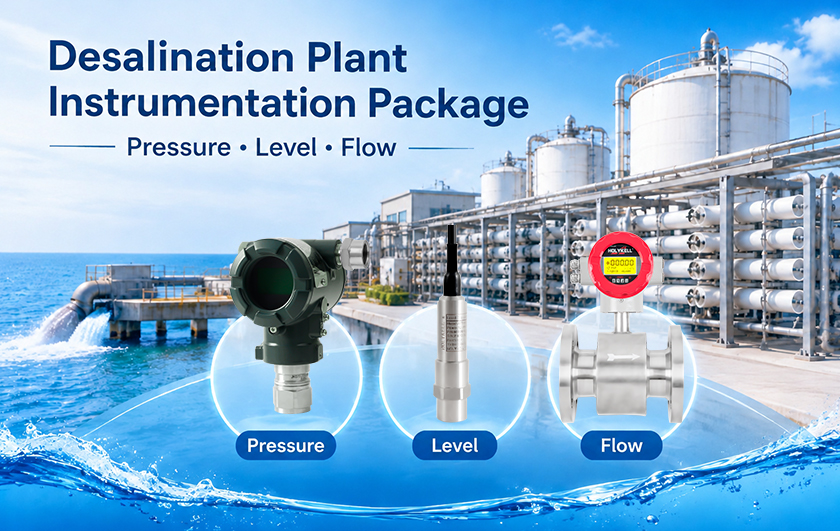
A seawater desalination plant typically requires pressure transmitters, level sensors, and flowmeters to monitor seawater intake, pretreatment, reverse osmosis (RO), freshwater production, and brine discharge.
The appropriate instrumentation depends on the process stage, operating pressure, liquid characteristics, installation conditions, and corrosion requirements.
By selecting the correct materials, measurement ranges, installation methods, and output interfaces, EPC contractors can integrate these instruments into a complete process monitoring system.
For a new desalination project, instrument selection should begin with the P&ID, Instrument Index, equipment list, and process datasheets rather than selecting products based on model numbers alone.
1. Why Is Instrument Selection Critical for Seawater Desalination Plants?
Seawater desalination plants operate under demanding conditions. High salinity, corrosive liquids, elevated operating pressure, continuous operation, and varying water quality all affect instrumentation performance.
For EPC contractors, selecting unsuitable instruments can lead to premature corrosion, unstable measurement signals, additional maintenance, and unexpected replacement costs.
1.1 Common Instrumentation Challenges in Desalination Projects
Seawater Corrosion
Seawater contains dissolved salts, particularly chlorides, which can cause corrosion of metallic components.
Standard stainless steel materials may not be suitable for every seawater application, especially under higher temperatures, stagnant conditions, or concentrated chloride exposure.
The wetted materials of pressure sensors, level transmitters, and flowmeters must therefore be evaluated according to the actual process medium.
High-Pressure Operating Conditions
Reverse osmosis systems require high-pressure pumps to overcome the osmotic pressure of seawater. Pressure instruments installed around the high-pressure pump, RO feed pipeline, and membrane system must be selected according to normal operating pressure, maximum pressure, pressure fluctuations, and potential water hammer.
Continuous Flow Measurement
Seawater intake, RO feed, permeate production, and brine discharge require reliable flow measurement.
Incorrect flow measurement can affect water production calculations, process control, and overall plant efficiency.
Different Installation Environments
Some instruments are installed directly in pipelines, while others are mounted on tanks, reservoirs, or open water structures.
Selecting the correct threaded, flanged, or submersible installation arrangement is essential for reliable operation.
2. Where Are Pressure Sensors, Level Transmitters, and Flowmeters Used in a Desalination Plant?
A seawater desalination plant consists of several treatment stages, each requiring different pressure, level, and flow measurements. The following table summarizes typical instrumentation applications and recommended HOLYKELL solutions.
| Process Stage | Measurement Requirements | Recommended HOLYKELL Instrument |
|---|---|---|
| Seawater Intake | Intake pipeline pressure and seawater flow | HK7 Pressure Sensor / Electromagnetic Flowmeter |
| Seawater Storage | Reservoir and tank level | HPT608 Level Transmitter |
| Pretreatment | Filter inlet/outlet pressure and treated water flow | HK7 Pressure Sensor / Electromagnetic Flowmeter |
| RO High-Pressure System | High-pressure pump discharge and RO feed pressure | HK7 Pressure Sensor |
| RO Permeate Outlet | Freshwater production flow | Electromagnetic Flowmeter |
| Brine Discharge | Concentrated seawater flow | Electromagnetic Flowmeter |
| Product Water Storage | Freshwater tank and reservoir level | HPT608 Level Transmitter |
3. HOLYKELL Instrumentation Solutions for Desalination Projects
HOLYKELL provides pressure measurement, liquid-level measurement, and flow measurement instruments that can be selected according to different desalination process requirements.
3.1 HK7 Pressure Sensor Series: Flexible Pressure Measurement for Different Process Conditions
The HK7 pressure sensor series offers different material, diaphragm, and installation configurations, allowing engineers to select a suitable pressure measurement solution for different water treatment applications.
Why Consider the HK7 Series?
- Single-Crystal Silicon Technology – Enables precise pressure, level, density, and flow measurement across seawater treatment processes.
- High Accuracy up to ±0.01% – Ensures reliable process monitoring and precise control in critical desalination operations.
- HART Smart Communication – Enables remote configuration, diagnostics, and monitoring, reducing maintenance workload in treatment facilities.
- Advanced EMC Protection – Ensures stable and reliable measurement signals in electrically complex desalination plants.
- Dual Overload Protection up to 40 MPa – Withstands demanding high-pressure conditions in reverse osmosis (RO) systems, improving operational reliability.
Using one pressure sensor configuration for every application may not be appropriate. The HK7 series provides configuration flexibility to match different project requirements.
Key selection considerations include:
| Selection Parameter | Engineering Consideration |
|---|---|
| Pressure Range | Match the normal and maximum operating pressure |
| Wetted Material | Select according to seawater, freshwater, or chemical compatibility |
| Diaphragm Material | Evaluate chloride corrosion resistance and process compatibility |
| Pressure Connection | Select the appropriate threaded or other available process connection |
| Electrical Connection | Match the cable, connector, and installation environment |
| Output Signal | Confirm compatibility with PLC, DCS, or other control systems |
Why Is Material Selection Important?
For seawater applications, the wetted parts are particularly important. Engineers should evaluate the diaphragm and process connection materials rather than considering only the external housing material.
For example, 316L stainless steel may be suitable for certain freshwater and less aggressive applications, but it should not automatically be assumed suitable for every seawater or concentrated brine condition.
For higher-corrosion environments, more corrosion-resistant material options may be required, subject to actual HK7 configuration availability and engineering verification. The HK7 series should therefore be selected based on the process medium, chloride concentration, temperature, pressure, and required service life.
3.2 HPT608 Level Transmitter: For Seawater and Corrosive Liquid Applications
Level measurement is required in seawater intake reservoirs, pretreatment tanks, freshwater storage tanks, and other liquid storage structures. In these environments, the wetted housing material can directly affect the service life of the level transmitter.
The HOLYKELL HPT608 features
- All-Titanium Construction – Provides excellent corrosion resistance for long-term seawater and harsh chemical applications.
- High Measurement Accuracy – Accuracy up to ±0.25% F.S. ensures reliable seawater and fuel level monitoring.
- IP68 Fully Sealed Design – Ensures reliable underwater operation in seawater ballast tanks, pumping systems, and marine environments.
- Wide Measurement Range up to 200m – Offers flexible level measurement for deep-water applications, ship draught, and sea port monitoring.
- 300% F.S. Overload Protection – Withstands pressure surges and demanding operating conditions for enhanced measurement reliability.
- Two Installation Options–Two installation arrangements available according to the tank structure: Threaded Installation or submersible Installation.
Why Choose Titanium Housing?
Titanium offers good resistance to seawater corrosion and is widely used in marine and chemical processing environments.
Compared with conventional stainless steel options, titanium can provide advantages in chloride-rich environments when the complete wetted assembly is appropriately designed.
3.3 Electromagnetic Flowmeters: Reliable Flow Measurement for Conductive Liquids
Magnetic flowmeters are suitable for many desalination applications involving seawater, freshwater, and brine.
Why Use Electromagnetic Flowmeters in Desalination Plants?
Key advantages include:
- No moving mechanical parts in the measuring tube.
- No additional pressure loss caused by an internal obstruction.
- Suitable for conductive seawater and treated water.
- Suitable for many brine flow measurement applications.
- Available with different pipeline diameters and connection configurations.
Important Selection Considerations
Not every electromagnetic flowmeter is suitable for every desalination pipeline. Before selection, confirm:
- Liquid Conductivity: Seawater and most brines are conductive, but the actual conductivity should meet the selected meter’s minimum requirement.
- Lining Material: The liner must be compatible with seawater, brine, temperature, and operating conditions.
- Electrode Material: Electrode material must be evaluated against chloride concentration and the chemical composition of the liquid.
- Pipeline Diameter: Select the meter according to actual pipe size and required flow velocity.
- Installation Conditions: The measuring tube should normally remain completely filled with liquid.
- Grounding: Proper grounding and grounding-ring arrangements may be required depending on pipeline material and installation conditions.
For high-salinity brine or chemically aggressive process liquids, lining and electrode compatibility should be confirmed before procurement.
4. How to Select the Right Instruments for a Desalination EPC Project
For international EPC projects, instrument selection often starts before all process parameters are finalized. Engineers may receive an incomplete Instrument Index, preliminary P&ID, or equipment schedule during the tender stage.
In these situations, suppliers should be able to provide engineering support rather than simply quote standard products. The following selection workflow can help reduce technical mismatches.
4.1 Step 1: Identify the Process Medium
First, identify the process medium at each location. Seawater, freshwater, concentrated brine, and chemical cleaning solutions have different material compatibility requirements. This is one of the most important steps in seawater desalination instrumentation selection. The correct material depends on chloride concentration, temperature, chemical exposure, and operating conditions.
4.2 Step 2: Confirm Pressure, Level, and Flow Ranges
For pressure sensors, collect normal operating pressure, maximum pressure, and required overload capacity.
For level transmitters, confirm tank height, liquid density, and installation depth.
For flowmeters, provide pipeline diameter, minimum and maximum flow, and normal operating flow.
Avoid selecting an instrument based only on nominal pipeline pressure or tank height.
4.3 Step 3: Confirm Installation and Electrical Interfaces
Check whether the instrument requires threaded, flanged, or submersible installation. Also confirm the following:
- Supply voltage.
- Output signal, such as 4–20 mA or RS485 where supported by the selected model.
- Cable and connector requirements.
- IP protection requirements.
- PLC or DCS integration.
- Hazardous-area certification, if required.
5. Frequently Asked Questions
Q1: Why is titanium considered for seawater level measurement?
Titanium offers good resistance to seawater corrosion and is often considered for marine and chloride-rich environments. A titanium-housing level transmitter can be a suitable option, provided its diaphragm, seals, cable assembly, and other wetted components are also compatible with the process medium.
Q2: Can one instrumentation supplier provide pressure, level, and flow measurement products for a desalination project?
Yes. Working with one supplier for multiple measurement categories can simplify technical communication, datasheet review, quotation coordination, and procurement management. However, each instrument must still meet its individual process and project specifications.
Q3: Are electromagnetic flowmeters suitable for concentrated brine?
They can be suitable because brine is generally electrically conductive. However, electrode and lining materials must be selected according to the actual salt concentration, temperature, chemical composition, and operating conditions.
6. Get a Customized Desalination Plant Instrumentation Package from HOLYKELL
Selecting instruments for a seawater desalination plant requires a clear understanding of process conditions, liquid properties, installation arrangements, and control system requirements. Contact our engineers for guidance.
About Author
Li Fei is a Senior Engineer at HOLYKELL, specializing in industrial sensing solutions including level measurement, pressure monitoring, and IoT-based sensor applications.
With practical experience supporting customers in water management, industrial automation, and environmental monitoring applications, Li Fei shares technical insights to help engineers and project managers select suitable measurement solutions.